






What Caravans Not to Buy in Australia: A Practical Buyer’s Checklist
Reversing a caravan is one of those skills that looks impossible right up until the moment it “clicks”. The reason it feels hard at first isn’t because you’re bad at driving. It’s because reversing a trailer is counterintuitive. Small steering inputs create big changes at the back of the van, and if you react too late, things escalate quickly.
The fastest way to get good isn’t a secret technique. It’s learning a few core principles, practising in a low-pressure space, and using a method that keeps you calm and in control. This guide is written for first-timers. If you can reverse a car, you can learn to reverse a caravan, and you’ll be surprised how quickly it improves once you stop trying to “fight” it.
Before you start: set yourself up for success
Reversing goes wrong most often because people try to do it too fast, in too tight a space, with poor visibility. So start by making the conditions easy.
Find a quiet car park or open area for practice. If you’re in a caravan park, don’t be shy about waiting for a gap in traffic or asking for a moment to set up properly; everyone has been the “new person” at some point. A few basic setup habits help immediately:
- Use a spotter if you have one (agree on simple hand signals first).
- Walk the path before you reverse: check for posts, rocks, dips, taps, power poles, and tree branches.
- Set mirrors properly so you can clearly see down both sides of the caravan.
- Go slow enough that you can stop instantly if something doesn’t look right.
If you ever feel rushed, stop. The caravan isn’t going anywhere without you.
The one rule that changes everything: small inputs, slow speed
Most reversing problems come from oversteering and reacting too late. The fix is almost always the same:
Go slower than you think, and use smaller steering inputs than you think.
At low speed, you have time to correct. At higher speeds, the angle builds quickly and becomes harder to recover. If you feel the caravan “starting to run away”, don’t keep turning harder. Stop, straighten up, and try again.
Understanding what the caravan is doing (without complicated theory)
When reversing a caravan, the caravan wants to turn opposite to the direction you last moved the steering wheel. That’s why it feels backwards. A simple way to think about it is this:
- You’re steering the car to change the angle between the car and the caravan (the “hinge” point).
- That angle is what makes the caravan turn.
If the angle gets too sharp, the caravan turns faster and becomes difficult to control. Your job is to keep the angle small and manageable.
The easiest steering trick for beginners: the “hand at the bottom” method
If “turn left to go right” is melting your brain, use this shortcut.
Put one hand at the bottom of the steering wheel.
- Move your hand left → the back of the caravan tends to go left
- Move your hand right → the back of the caravan tends to go right
It’s not magic. It just makes your steering direction match what you see in the mirrors, which is exactly what beginners need.
A simple reversing method that works in most situations
When you’re reversing into a site or driveway, use this sequence. It keeps you calm and stops you from chasing the caravan.
1) Set your starting position (“the setup matters”)
Don’t start reversing from wherever you happen to be. Move forward and position the car and caravan so you have:
- a clear view down the side you’re reversing toward
- enough room to swing
- as straight an entry line as possible
The better your setup, the less steering you need.
2) Start straight, then introduce the turn gently
Begin reversing with the car and van mostly straight. Add a small steering input to start the caravan moving in the direction you want.
The keyword is small. Let the caravan respond before you add more.
3) Follow the caravan with your vehicle
Once the caravan starts to angle into the space, you’ll usually need to steer the vehicle the other way to “follow” it and prevent the angle from becoming too sharp.
This is the part beginners miss. They keep steering the caravan into the turn, but forget to follow it, so the angle tightens, and everything accelerates.
4) Pause and straighten when needed
If the angle looks too sharp, stop. Pull forward to straighten the van and reset.
This is normal. Even experienced towers pull forward to straighten. It’s not failure, it’s good driving.
The correction rule: fix it early, not late
The caravan responds with a delay. If you wait until it looks “really wrong”, you’ll need a big correction, which usually makes it worse.
Instead, make small corrections early:
- if the caravan is drifting too far left, correct right early
- if it’s drifting too far right, correct left early
Reversing becomes easy when your corrections are tiny and frequent, not big and panicked.
How to reverse into a caravan park site (the common scenario)
Most caravan park sites are a variation of the same problem: you need to reverse into a space between posts/trees with limited room.
A few practical tips make this dramatically easier:
Choose the best mirror to commit to
If you can, reverse toward the side where you have the clearest view down the caravan (often the driver’s side). Better visibility = better control.
Aim for a “gentle arc,” not a sharp turn
A gentle arc is easier to control and easier to correct.
Use reference points
Pick a fixed point on the site (like the inside corner of the pad) and use it as a target. Your brain does better with a target than with abstract “space”.
Stop before you’re too deep
Many people reverse too far before adjusting. If you’re not happy with the line, stop early and reset.
How to reverse into a driveway (and avoid jackknifing)
Driveways can be harder because the angle is often sharper, and you may have obstacles like fences, mailboxes, gutters, or a slope. For driveways, the best strategy is usually:
- Set up wide and slow
- Start with the caravan as straight as possible
- Use tiny steering inputs to begin the angle
- Follow the caravan quickly to prevent the angle from tightening too far
If the driveway is narrow, don’t be afraid to use a spotter and take multiple small repositioning moves. The goal is clean and safe, not “one perfect swing”.
A 30-minute practice plan that builds confidence fast
If you practice for half an hour in a quiet open space, you’ll improve quickly.
- Straight-line reverse (5 minutes): Reverse in a straight line using mirrors only.
- Gentle left and right arcs (10 minutes): Create a wide “S” path with small steering inputs.
- Reverse into a “site” (10 minutes): Use cones, bags, or markers to simulate a campsite entrance.
- Reset practice (5 minutes): Practice pulling forward to straighten and restarting. This is a real skill, not a backup plan.
That last part matters because it removes pressure. Once you’re comfortable resetting, reversing stops being stressful.
Safety habits that experienced towers swear by
Reversing a caravan isn’t just about skill. It’s also about reducing risk.
- Never rely on one mirror only (keep scanning both sides)
- Go slow enough to stop instantly
- Get out and check if you’re unsure (as many times as needed)
- Use a spotter and agree on signals (and a “stop now” signal)
- Avoid distractions. Reversing is the time for focus, not conversation
How this applies to touring with Century Caravans
One of the underrated benefits of choosing a caravan that suits your touring style is how confident you feel doing the everyday manoeuvres – reversing into sites, adjusting position, lining up on uneven ground, and setting up quickly.
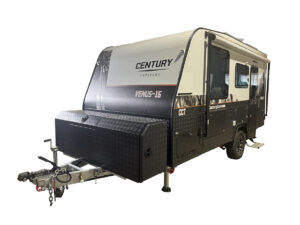
Century Caravans’ Venus range spans compact touring sizes through to longer “home base” layouts, and many buyers find that once they’re matched to the right footprint for their tow vehicle and travel style, reversing becomes less stressful simply because the combination feels more predictable.
The key isn’t being brave. It’s having a towing setup you can control calmly. Good mirrors, slow speed, small inputs, and a willingness to reset will take you a long way.
FAQ
Why does the caravan go the “wrong way” when I reverse?
Because you’re steering the car, which changes the angle at the hitch point. That angle makes the caravan turn. It’s counterintuitive at first, but it becomes natural with practice.
What’s the best speed to reverse a caravan?
Very slow. Slow gives you time to correct early and prevents the angle from building too quickly.
Should I reverse using the rear camera?
Cameras are helpful, but mirrors are the primary tool because they show the caravan’s angle and clearance down both sides. Use the camera as support, not as your only view.
How do I fix it when I’m getting into a jackknife angle?
Stop, pull forward to straighten the caravan, reset your position, and try again with smaller steering inputs. Resetting is normal.