







What Size Caravan Do I Need? 11ft vs 13ft vs 14ft vs 16ft vs 19ft
Choosing the right caravan size is one of the biggest decisions you will make before buying. It affects almost everything: how easy the caravan is to tow, where you can store it, how much space you have inside, how comfortable longer trips feel and how much self-sufficiency you can build into the van.
The tricky part is that bigger is not automatically better. A larger caravan can give you more comfort, more storage and a more spacious layout, but it may also require a stronger tow vehicle, more storage space at home and more confidence when reversing or manoeuvring. A smaller caravan can be easier to tow and live with, but it needs a smart layout because every centimetre matters.
The best caravan size is not the one that looks most impressive in a showroom. It is the one that suits the way you actually travel.
This guide compares common compact and mid-sized caravan options, from 11ft through to 19ft, and explains how to think about layout, towing, comfort and long-term usability before you choose.
Start with how you travel, not the number of feet
It is tempting to begin with a size: 11ft, 13ft, 14ft, 16ft or 19ft. But the better starting point is your travel style.
A couple doing short weekend escapes has different needs from a couple planning long free-camping trips. Someone who mostly stays in caravan parks may not need the same water, power or off-road capability as someone who wants to spend several nights away from powered sites. A traveller who cooks outside and spends most evenings under the awning may be happy with a compact interior, while someone who wants more indoor lounging space may prefer a longer caravan.
Before comparing sizes, ask yourself a few practical questions:
Will most of your trips be weekends, longer touring loops or extended travel? Will you stay mostly in caravan parks, free camp regularly or do a mix of both? Do you need a shower and toilet inside the caravan? Do you want a permanent bed, or are you comfortable converting a lounge? How confident are you with towing, reversing and maneuvering? And, just as importantly, what can your tow vehicle comfortably and legally handle?
Once you answer those questions, the right size usually becomes much clearer.
11ft caravans: compact, self-contained and easy to live with
An 11ft caravan suits travellers who want the smallest practical footprint without giving up the essentials. It is especially appealing if you want something easier to tow, store and manoeuvre, but still want the comfort of an internal kitchen and ensuite.
The main advantage of an 11ft caravan is simplicity. It feels less intimidating than a larger van, which can make weekend trips easier to say yes to. You are not dragging around more caravan than you need, and you can often fit into tighter sites or storage spaces more comfortably.
The trade-off is that the layout has to work very hard. At this size, one area will often serve more than one purpose. A lounge may convert into a bed, storage needs to be deliberate and the ensuite will be compact rather than spacious.
The Century Caravans Venus 11 Plus is a good example of this type of layout. It is an 11ft on-road caravan designed for two people, with a U-shaped lounge that converts into an approximately 2000mm by 1600mm bed. It also includes an in-built ensuite with toilet and shower, an internal kitchen, 80L fresh and 80L grey water tanks, a 100Ah lithium battery and 200W solar.
That makes it a strong fit for buyers who want a compact, self-contained caravan for weekends, caravan parks and light touring, without moving into a larger towing setup.
An 11ft caravan may suit you if you value manoeuvrability more than maximum interior space, travel as a couple, spend most of your time outdoors and are comfortable with a convertible sleeping arrangement.
13ft caravans: still compact, but easier for daily movement
A 13ft caravan gives you a little more breathing room while still remaining firmly in the compact category. For many travellers, this is where small-caravan touring starts to feel more comfortable for longer trips.
The extra length can allow for more practical sleeping arrangements, better storage, larger water capacity or a more relaxed ensuite design. It may not sound like a huge difference on paper, but inside a compact caravan, even a small increase in length can change the daily rhythm significantly.
The Venus 13 shows how this works in practice. It is a 13ft on-road caravan for two people with a true north-south twin single-bed layout. That means each person has easier bed access, which can be especially useful on longer trips or for couples with different sleep schedules. It also includes an in-built ensuite, internal kitchen, 102L 12V fridge, 150L fresh water, 75L grey water, 200Ah lithium battery and 400W solar.
Compared with an 11ft layout, the Venus 13 places more emphasis on convenience. You do not need to convert the lounge into a bed, and the larger water and power setup gives it a stronger touring feel while still keeping the ATM at 1900kg.
A 13ft caravan may suit you if you want a compact caravan but prefer dedicated beds, more water capacity and more day-to-day ease than the smallest layouts provide.
14ft caravans: compact comfort with a more residential feel
A 14ft caravan can be a natural next step for buyers who still want a manageable size but are less willing to compromise on bed comfort or bathroom usability.
This is often where layouts start to feel more like a small home on wheels rather than a compact weekend setup. You may get a fixed bed, a more defined ensuite and better kitchen or storage flexibility. The caravan remains smaller than many full-size touring vans, but the comfort level increases noticeably.
The Venus 14 is designed around that idea. It is a 14ft on-road caravan for two people with a fixed queen-size bed, separate toilet and shower, internal kitchen, outdoor kitchen, 160L fresh water, 80L grey water, 200Ah lithium battery and 400W solar.
The biggest lifestyle difference is the fixed queen bed. You do not need to make up the bed each night, and the caravan feels more ready to use when you stop. The separate toilet and shower also create a more comfortable bathroom experience than many smaller wet-bath-style layouts.
The trade-off is towing weight. The Venus 14 has an ATM of 2500kg, which is a meaningful step up from the Venus 11 Plus and Venus 13. That does not make it difficult to tow automatically, but it does mean tow-vehicle suitability needs to be checked properly.
A 14ft caravan may suit you if you want compact touring comfort, a fixed bed, a more usable bathroom and enough water and power support for longer trips, while still avoiding the size of a larger 16ft or 19ft caravan.
16ft caravans: the popular couples’ sweet spot
A 16ft caravan is often where buyers feel they have reached the “sweet spot”. It is still manageable compared with larger caravans, but it usually offers a more complete touring layout: island bed, full ensuite, larger fridge, better kitchen flow and stronger off-grid support.
For couples who want to travel regularly, this size can feel like a very sensible balance. You gain more comfort without necessarily stepping into the bulk of a 19ft or larger caravan. Reversing, parking and manoeuvring can still feel approachable, especially compared with longer vans, but the interior becomes much more livable for extended travel.
Century Caravans offers the Venus 16 in both on-road and off-road versions. Both are 16ft hard-top caravans for two people with an island bed, full ensuite, internal kitchen, external 3-burner kitchen, 152L fridge, 150L fresh water, 75L grey water, 200Ah lithium battery, 400W solar and 2000W inverter. The published figures list a tare weight of 1900kg, towball weight of 150kg and advertised ATM of 2500kg, though final weights should always be confirmed against the current build and compliance plate.
The choice between the Venus 16 On Road and Venus 16 Off Road comes down to how you travel. If your trips are mostly sealed roads, established routes and caravan parks, the on-road version may give you the comfort and size you want without overbuying capability. If your plans include more unsealed roads, rougher campsites or mixed-road touring, the off-road version becomes the more natural fit.
A 16ft caravan may suit you if you want a proper couples’ touring layout, a permanent island bed, internal and outdoor cooking, stronger off-grid support and enough comfort for longer trips without moving into a large caravan.
19ft caravans: more space, more comfort and a stronger home-base feel
A 19ft caravan suits travellers who want more room to settle in. It is less about pure compactness and more about comfort, storage, stronger touring systems and a more spacious “home base” feeling.
This size can be especially appealing if you take longer trips, spend more evenings inside, carry more gear or want a layout that feels less condensed. You may also gain larger water capacity, larger battery systems, more solar and more generous internal appliances.
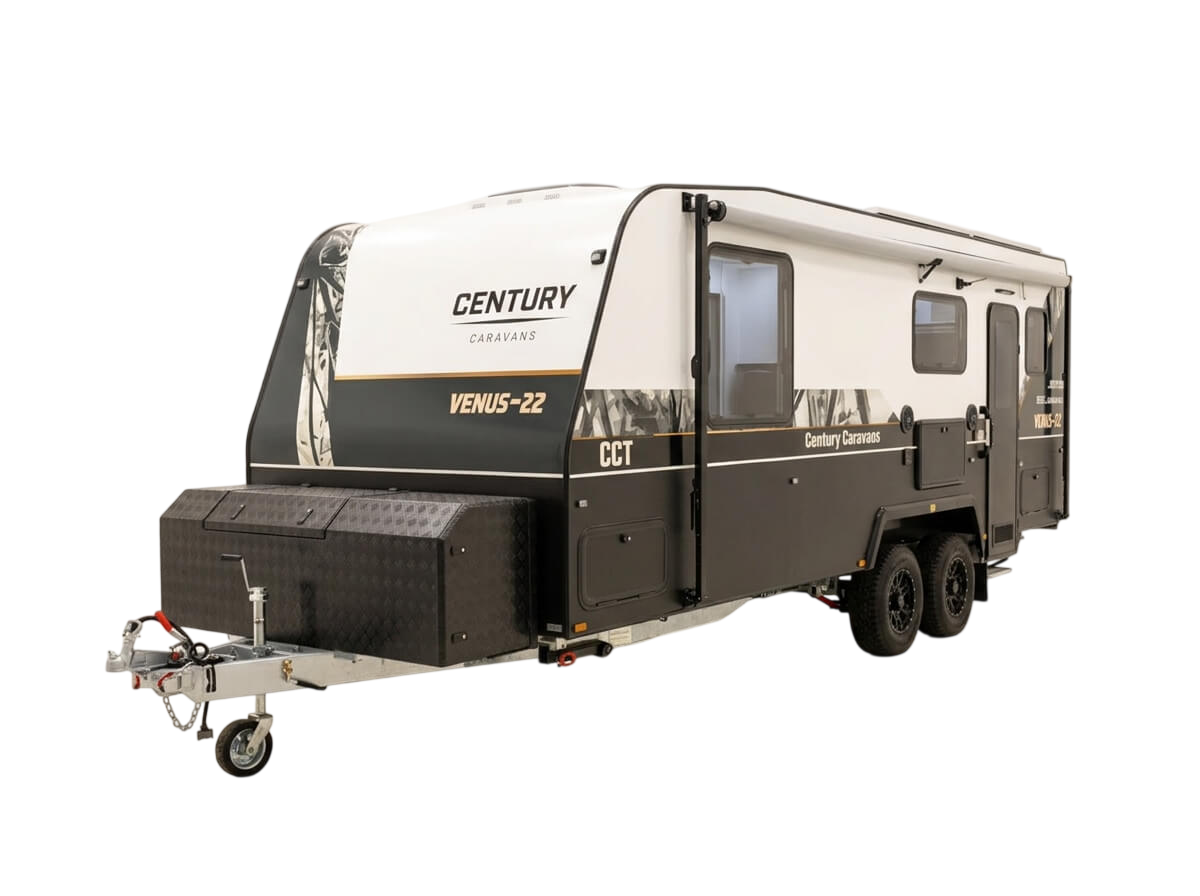
Century Caravans offers the Venus 19 in both on-road and off-road versions. The Venus 19 On Road is a 19ft pop-top-style on-road caravan for two people with an island bed, full ensuite, internal kitchen, outside kitchen, 225L fresh water, 75L grey water, 400Ah lithium battery, 600W solar and 2000W inverter. The Venus 19 Off Road offers a similar larger touring experience with off-road-focused foundations and is listed for three people.
Both Venus 19 models have an ATM of 3000kg, with a listed tare weight of 2260kg and towball weight of 170kg. That larger capacity and comfort package can be excellent for longer touring, but it also means tow vehicle compatibility becomes even more important.
A 19ft caravan may suit you if you want more internal comfort, stronger off-grid capacity, larger water storage, more room to relax and a layout that feels closer to a travelling home than a compact weekender.
The biggest trade-off: comfort versus manageability
The easiest way to think about caravan size is as a sliding scale.
At the smaller end, you gain easier towing, simpler storage, lower weight and a more nimble touring experience. But you give up some interior space, fixed furniture and storage capacity.
At the larger end, you gain comfort, more defined living zones, larger water and power systems, bigger appliances and a more relaxed interior. But you also need a suitable tow vehicle, more confidence when manoeuvring and more space to store the caravan when it is not in use.
There is no universally correct answer. A couple who spends most of their trip outside may be happier in a smaller, easier-to-manage caravan. Another couple who wants to travel for weeks at a time and spend more time inside may find a 16ft or 19ft layout far more enjoyable.
The best size is the one that removes the compromises you will notice most.
Do not choose by length alone
Caravan length is helpful, but it should never be the only deciding factor.
A 14ft caravan with a fixed queen bed and separate bathroom may suit one couple better than a 16ft layout. A 13ft caravan with twin singles may be more practical than an 11ft layout if you dislike converting a bed every night. A 16ft off-road caravan may be perfect for mixed touring, while a 19ft on-road caravan may be better if comfort and space matter more than rough-road capability.
Weights also matter. Length does not tell you the full towing story. You need to check ATM, tare weight, payload, towball weight and your tow vehicle’s limits. The difference between 1900kg ATM and 2500kg ATM is far more important than the difference between 13ft and 14ft on paper.
Water, power and accessories also influence the final touring setup. A caravan with more fresh water, lithium battery capacity, solar and an inverter may be more self-sufficient, but those systems add weight and cost.
How to match size to travel style
If you mostly do short weekend escapes and want something simple, an 11ft or 13ft caravan may be enough. These sizes are compact, easier to manage and still capable of offering an ensuite and practical kitchen.
If you want compact comfort but dislike daily setup compromises, a 14ft caravan may be a better fit. It can provide a fixed bed and more defined bathroom space while still remaining smaller than many full-size touring vans.
If you want a true couples’ touring setup for longer trips, a 16ft caravan is often the most balanced option. It gives you better livability, a more complete kitchen and ensuite setup, and stronger free-camping support.
If you want more space, larger systems and a home-base feel, a 19ft caravan becomes more appealing. This is especially true if you plan longer trips, carry more gear or prefer a more relaxed interior.
The right size becomes much clearer when you picture a real trip. Imagine arriving late, cooking in bad weather, showering after a long drive, packing up in the morning and reversing into a tighter site. The caravan that makes those moments easiest is usually the better choice.
A simple way to compare the Century Caravans Venus range
The Venus range gives buyers a useful size ladder because each model solves a slightly different problem.
The Venus 11 Plus is the most compact option, built for two people who want a small, self-contained on-road caravan with an ensuite and convertible lounge-bed setup.
The Venus 13 adds dedicated twin single beds, more water, more battery capacity and a stronger compact touring feel while still keeping the caravan easy to manage.
The Venus 14 moves toward greater comfort with a fixed queen bed, separate toilet and shower, outdoor kitchen and a more residential-style layout in a compact 14ft body.
The Venus 16 is the couples’ touring sweet spot, with an island bed, full ensuite, larger fridge, inside and outside cooking, inverter support and the choice between on-road and off-road builds.
The Venus 19 gives you the most space and strongest home-base feel in the Venus range, with larger water and power capacity, island bed comfort, internal and external cooking and on-road/off-road options depending on how you travel.
Rather than treating the models as “small to large”, it is more useful to see them as different travel personalities. The 11 Plus prioritises compact freedom. The 13 prioritises compact practicality. The 14 prioritises fixed-bed comfort. The 16 prioritises balanced couples’ touring. The 19 prioritises space and extended-trip comfort.
FAQ
What is the best caravan size for couples?
Many couples find 14ft to 16ft to be a comfortable range because it can include a fixed or island bed, ensuite and practical kitchen without becoming overly large. However, couples who value compact towing may prefer 11ft or 13ft, while those wanting more interior space may prefer 19ft.
Is an 11ft caravan too small?
Not necessarily. An 11ft caravan can work very well for two people if the layout is efficient and you are comfortable with compact living. It is best suited to travellers who value easy towing, simple storage and outdoor living.
Is a 16ft caravan easy to tow?
A 16ft caravan is often easier to manage than a larger van, but towability depends on weight, towball load, payload, tow vehicle limits and how the caravan is packed. Always check the full towing setup rather than relying only on length.
What size caravan do I need for free camping?
Free camping depends less on length and more on water, power and layout. Look for enough fresh and grey water, lithium battery capacity, solar, suitable cooking options and an ensuite if you want to stay away from facilities comfortably.
Should I choose a smaller caravan or a larger caravan?
Choose smaller if you value easier towing, storage and manoeuvrability. Choose larger if you want more comfort, storage, water capacity and interior living space. The right answer depends on how often you travel, where you stay and how much time you spend inside.
Does a longer caravan always have more payload?
No. Payload depends on ATM, tare weight and build specification. A longer caravan may have more capacity, but it may also include heavier appliances, water systems and features. Always check the actual specification.
Final takeaway
The right caravan size is the one that fits your travel rhythm.
An 11ft caravan can be perfect if you want compact, self-contained travel. A 13ft caravan adds daily convenience without becoming large. A 14ft caravan brings fixed-bed comfort and a more usable bathroom. A 16ft caravan often becomes the sweet spot for couples who want a complete touring setup. A 19ft caravan gives you more space, stronger systems and a more comfortable home-base feel.
Before choosing, think about how you travel on a normal day, not just how the caravan looks in a showroom. Consider sleeping, cooking, showering, storage, towing, water, power and how confident you feel manoeuvring the van.
For a practical comparison, explore the Century Caravans Venus range from the compact Venus 11 Plus through to the Venus 19 on-road and off-road builds, then request a quote for the size and layout that best matches your travel plans.
Tags :
example, category, and, terms