







What Caravans Not to Buy in Australia: A Practical Buyer’s Checklist
Choosing a caravan as a couple is not just about finding the right size. It is about finding a layout that makes daily travel feel easy.
A floor plan can look excellent on paper, but the real test is what happens on an ordinary touring day. Can one person make coffee while the other gets ready? Is the bed easy to access at night? Does the kitchen still work when the weather turns? Is the ensuite practical, or does it feel like a feature that was squeezed in for the brochure? Is there somewhere sensible for shoes, jackets, towels, food and the little things you use every day?
For couples, the best caravan layout is rarely the biggest one. It is the one that matches how you actually move, sleep, cook, shower and relax on the road.
This guide compares the most common caravan layouts for couples, the trade-offs behind each one and what to look for before choosing.
Start with your travel rhythm
Before comparing beds, bathrooms and kitchens, it helps to think about the kind of trips you take.
Some couples use their caravan mainly for weekends and short breaks. They want something easy to tow, quick to set up and simple to store at home. Others are planning longer touring loops where comfort, storage, water capacity and off-grid power matter more. Some spend most of their time outdoors under the awning. Others want an interior that feels comfortable during cold, wet or windy evenings.
There is no right answer. The important thing is to choose a layout for your real habits, not for an idealised version of travel.
A compact caravan can be perfect if you pack light and live mostly outside. A larger layout can be worth the extra size if you want a permanent bed, more storage and a more relaxed interior. The best layout is the one that removes the frustrations you would notice most often.
The convertible lounge-bed layout
A convertible lounge-bed layout is one of the most space-efficient choices for couples. During the day, the seating area works as a lounge and dining space. At night, it converts into the main bed.
This style suits couples who want the smallest practical caravan without losing self-contained comfort. It keeps the daytime interior open and flexible, which is especially useful in shorter vans where a permanent bed would occupy most of the available space.
The trade-off is the nightly routine. You need to convert the lounge into a bed, then convert it back again if you want daytime seating. Some travellers do not mind this at all, especially on shorter trips. Others quickly decide they want a permanent bed that is always ready.
Bedding storage also matters. Pillows, doona and sheets need somewhere to go when the lounge is being used, and that storage should be easy to access rather than awkwardly tucked away.
The Century Caravans Venus 11 Plus is a good example of this compact couple-focused approach. It uses a U-shaped lounge that converts into an approximately 2000mm by 1600mm bed, while still including an internal kitchen and a private ensuite with shower and toilet. For couples who value easy towing, compact storage and self-contained travel, this kind of layout can make a lot of sense.
It is best for couples who travel light, spend plenty of time outdoors and prefer a smaller caravan over a permanent sleeping zone.
The twin single-bed layout
Twin single beds can be surprisingly practical for couples, especially on longer trips.
The main advantage is access. Each person has their own bed, so no one has to climb over the other during the night. This can be especially useful if you have different sleeping patterns, wake up at different times or simply prefer more personal space.
Twin beds can also improve the flow of a compact caravan. In some layouts, north-south single beds create a clear walkway through the centre, making it easier to move between the kitchen, bathroom and sleeping area.
The trade-off is that it feels less like a traditional shared bedroom. Some couples love the practicality; others prefer the comfort and closeness of a queen or island bed.
The Venus 13 shows how a twin-bed layout can work in a compact touring caravan. It is a 13ft on-road caravan for two people with north-south twin single beds, an in-built ensuite, internal kitchen, 102L 12V fridge, 150L fresh water, 75L grey water, 200Ah lithium battery and 400W solar. Compared with the smallest layouts, it gives couples easier bed access and a stronger touring feel while staying compact.
This type of layout suits couples who want convenience, personal sleeping space and easier movement inside the caravan, without moving into a much larger van.
The fixed queen-bed layout
A fixed queen bed is often the point where compact caravan travel starts to feel more residential.
The appeal is simple: the bed is always ready. You do not need to make it up at night, rearrange cushions or find a place to store bedding during the day. For many couples, that convenience becomes more important the longer they travel.
A fixed queen bed can also make the caravan feel more like a small bedroom, which is appealing if you want the comfort of home in a manageable footprint.
The trade-off is space. A permanent bed occupies a significant portion of the caravan, so the rest of the layout needs to be designed carefully. Kitchen bench space, seating, storage and bathroom placement all become more important because there is less flexibility than in a convertible design.
The Venus 14 is a good example of this step up in comfort. It combines a fixed queen-size bed with a separate toilet and shower, internal kitchen, outdoor kitchen, 160L fresh water, 80L grey water, 200Ah lithium battery and 400W solar. It remains compact compared with many full-size vans, but it prioritises the comforts couples often notice most: a ready-made bed, a more defined bathroom and practical cooking options.
This layout suits couples who want compact touring without giving up the convenience of a permanent bed.
The island-bed layout
For many couples, an island bed is the most comfortable caravan sleeping arrangement.
The main benefit is access from both sides. Each person can get in and out without disturbing the other, and the bed area feels more like a proper bedroom. On longer trips, that small daily convenience can make the caravan feel much easier to live in.
Island beds usually appear in larger compact and mid-sized caravans because they need more room around the bed. That extra space can also support better storage, a larger fridge, a fuller kitchen and a more comfortable ensuite.
The trade-off is that the caravan generally becomes longer and heavier than smaller layouts. You gain comfort and livability, but you also need to think more carefully about towing, storage and tow vehicle suitability.
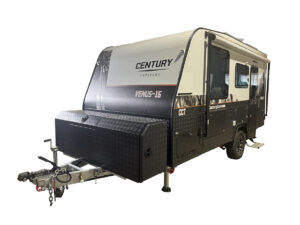
The Venus 16 range sits naturally in this category. Both the Venus 16 On Road and Venus 16 Off Road are 16ft caravans for two travellers, with an island bed, full ensuite, internal kitchen, external 3-burner kitchen, 152L fridge, 150L fresh water, 75L grey water, 200Ah lithium battery, 400W solar and a 2000W inverter. The on-road version suits established touring routes and sealed-road travel, while the off-road version is designed for buyers who want more confidence on mixed roads.
For couples who want a balanced touring setup, the island-bed layout often feels like the sweet spot: still manageable, but much more comfortable for extended travel.
Larger couples layouts: more space and a home-base feel
Some couples know from the beginning that they want more room. They may travel for longer periods, carry more gear, spend more evenings inside or simply prefer a caravan that feels less compact.
A larger couples layout can provide more generous storage, greater water capacity, stronger power systems, a larger lounge area and a more relaxed interior. It can also feel better during bad weather because there is more room to move without constantly stepping around each other.
The Venus 19 models fit this kind of travel. The Venus 19 On Road offers a spacious 19ft setup for two people with an island bed, full ensuite, internal and outside kitchen, 225L fresh water, 75L grey water, 400Ah lithium battery, 600W solar and a 2000W inverter. The Venus 19 Off Road takes the same broader home-base idea into an off-road-focused build, with touring hardware such as a Cruisemaster DO35 coupling and independent suspension, plus generous off-grid support.
The trade-off is obvious: more caravan means more towing responsibility. You need a suitable tow vehicle, more storage space when the caravan is not in use and more confidence when reversing and manoeuvring.
A larger couples layout suits travellers who prioritise long-trip comfort, stronger self-sufficiency and a more spacious interior over having the smallest possible footprint.
Ensuite placement and bathroom comfort
For many couples, a shower and toilet are not optional. They provide privacy, flexibility and comfort, especially when free camping or travelling outside peak season.
But not all ensuites feel the same.
In compact caravans, the ensuite may be designed as a combined wet bathroom. This is efficient and allows a shower and toilet to fit into a smaller footprint. In larger compact layouts, the shower and toilet may be more separated, which can feel closer to a home-style bathroom.
When comparing layouts, do not judge the ensuite only by whether it exists. Step inside if you can. Check headroom, door position, ventilation, towel storage and whether the toilet can be used comfortably. Think about where wet towels will go and how easy the room will be to air out after a shower.
A compact ensuite is perfectly workable if it is designed well. A larger ensuite is not always better if it steals too much space from the living area you use every day.
Kitchen layout: inside, outside or both?
Couples often underestimate how much the kitchen affects touring comfort.
An internal kitchen matters because not every day is sunny and calm. You need to be able to make coffee, cook a simple meal and use the sink comfortably when the weather is poor.
An outside kitchen is useful because so much Australian caravan travel happens outdoors. It keeps heat and cooking smells outside, suits awning living and makes quick roadside meals easier.
The best layout depends on how you cook. If you mostly prepare simple meals, a compact internal kitchen may be enough. If you enjoy cooking outdoors, look for a layout with an external kitchen or BBQ gas bayonet. If you travel longer, storage for pantry items, cookware and cleaning gear becomes just as important as the cooktop itself.
The strongest couples layouts do not treat the kitchen as a feature box to tick. They make cooking feel natural.
Storage: the quiet difference between easy and annoying
Storage rarely looks exciting in a brochure, but it is one of the biggest differences between a caravan that feels easy and one that feels frustrating.
Good storage is not just about volume. It is about location.
Kitchen items should be near the kitchen. Bathroom items should be near the bathroom. Daily-use items should be easy to reach. Heavy items should have sensible low storage, ideally closer to the axle line for better towing balance.
Couples should also think about the small items that create clutter: shoes, jackets, charging cables, toiletries, towels, books, hats, keys and outdoor gear. If there is no natural place for these things, the caravan can feel messy even when it technically has enough storage.
When inspecting a layout, open every cupboard and ask what would actually live there.
Seating and indoor living
Some couples barely use the indoor lounge. They wake up, make coffee, head outside and spend most of the day under the awning or exploring.
Other couples want a comfortable place to sit in the evening, eat inside, use a laptop or relax during rain.
This is why seating should be judged against your travel style. A compact dinette may be perfectly fine for short stays and outdoor-focused travel. A larger lounge or more open seating zone may be worth the extra length if you spend more time inside.
Do not choose the biggest lounge because it looks comfortable in the showroom. Choose the one that suits how often you will actually use it.
On-road vs off-road layout considerations
The interior layout is only half the decision. Couples also need to think about the roads they plan to take.
An on-road caravan may be the right choice if most of your travel involves sealed roads, caravan parks and established routes. In that case, your budget can go toward comfort, appliances and day-to-day usability rather than off-road hardware you may not fully use.
An off-road caravan may be the better fit if you want more confidence on unsealed roads, rougher campsites and mixed touring routes. In that case, the foundations matter: suspension, coupling, clearance, underbody protection, dust sealing and durability.
The layout inside still matters, but the caravan also needs to be built for the conditions outside.
Century’s Venus range makes this comparison straightforward because buyers can move from compact on-road layouts through to larger on-road and off-road builds. The decision becomes less about chasing the “best” caravan and more about choosing the layout and foundation that match your travel plans.
How to test a couples layout before buying
A showroom inspection should feel like a rehearsal, not a quick look.
Both people should stand inside the caravan at the same time. One person should pretend to cook while the other moves from the bed to the bathroom. Open the fridge, cupboards, drawers and ensuite door. Sit where you would sit at night. Stand in the shower. Try getting in and out of bed from both sides if possible.
Then imagine a wet evening. Could you both move around without getting irritated? Could you prepare dinner? Is there space for towels and jackets? Would the layout still feel comfortable after a week?
These small tests reveal more than the floor plan.
Which layout is best for which couple?
A convertible lounge-bed layout suits couples who want the smallest practical footprint and do not mind a little nightly setup.
Twin singles suit couples who value easy bed access, personal sleeping space and practical movement.
A fixed queen bed suits couples who want compact comfort with less daily rearranging.
An island bed suits couples who want the most comfortable sleeping arrangement and a stronger touring feel.
A larger 19ft layout suits couples who want more space, greater self-sufficiency and a home-base style of travel.
The best choice depends less on the industry category and more on which inconvenience you want to avoid.
FAQ
What is the best caravan layout for couples?
The best caravan layout for couples is one that matches how you travel. Many couples prefer an island bed and ensuite for longer trips, while others prefer compact layouts with a convertible lounge or twin single beds for easier towing and smaller storage needs.
Is an island bed worth it in a caravan?
For many couples, yes. An island bed gives easier access from both sides and feels more like a proper bedroom. The trade-off is that it usually requires a larger caravan than a compact lounge-bed or twin-bed layout.
Are twin beds practical for couples?
Yes. Twin beds can be very practical for touring couples, especially if each person wants easy access, personal space or different sleeping routines. They may feel less traditional than a queen bed, but they often improve movement inside a compact caravan.
Do couples need a caravan with a shower and toilet?
Not every couple needs one, but many prefer it for privacy, free camping and convenience. An ensuite can make longer trips easier and reduce reliance on caravan park amenities.
What size caravan is best for couples?
Many couples are comfortable in the 14ft to 16ft range, but the right size depends on towing confidence, storage space, trip length and desired comfort. Some couples prefer an 11ft or 13ft compact caravan, while others prefer the extra space of a 19ft layout.
Should couples choose an on-road or off-road caravan?
Choose on-road if most trips are on sealed roads and established routes. Choose off-road if you regularly plan to travel on unsealed roads, rougher campsites or more remote touring routes.
Final takeaway
The best caravan layout for couples is the one that makes ordinary travel feel simple.
A compact convertible layout can give you a small, self-contained caravan without unnecessary bulk. Twin singles can make day-to-day movement easier. A fixed queen bed adds convenience. An island bed creates a more comfortable touring feel. A larger layout gives you space, storage and a stronger home-base experience.
Before choosing, think carefully about how you sleep, cook, shower, relax and move around the caravan together. Then compare layouts based on the trade-offs you would actually notice on the road.
For real examples across the size range, explore the Century Caravans Venus 11 Plus, Venus 13, Venus 14, Venus 16 and Venus 19 models. Each one solves the couples-layout question differently, from compact self-contained touring through to larger on-road and off-road comfort.
Tags :
example, category, and, terms