




How to Load a Caravan Safely (Weight Distribution & Stability)
“Can I tow this caravan?” sounds like a single-number question. Most people look at a tow rating, compare it to a caravan weight, and assume they’re done.
But safe towing in Australia is rarely that simple, because towing is a system. The caravan has limits (like ATM and towball weight). Your tow vehicle has limits (like GVM, GCM, maximum towball download, and rear axle load). And then real life happens: passengers, luggage, a full tank of water, bikes, tools, an extra battery, aka all the stuff you’ll actually travel with.
The good news is you don’t need to be an engineer to check this properly. You just need the right numbers, in the right order, and a realistic view of how you’ll load up. This guide walks you through a simple, repeatable way to answer the question with confidence.
Quick note: This is general information, not legal or mechanical advice. Vehicle limits vary by make/model and sometimes by variant. Always confirm figures in your owner’s manual/compliance labels and talk to a qualified towing professional if you’re unsure.
The mistake most buyers make: only checking “towing capacity”
Your vehicle’s braked towing capacity matters, but it’s often not the first limit you’ll hit. For many real touring setups, the bottlenecks are more likely to be:
- Maximum towball download (how much weight the car can carry on the tow ball)
- Vehicle payload/GVM headroom (how much you can load into the car)
- Rear axle load (how much weight ends up on the back wheels)
- GCM (how heavy the car and caravan can be combined)
That’s why two people can own the same car and have completely different towing outcomes. The difference is usually not the tow rating. It’s how the vehicle is loaded, and what the caravan is doing at the hitch.
The 7 numbers you need (and where to find them)
Before you do anything else, gather the inputs. Think of this as your “towing checklist”, but we’ll use it to build a clear decision.
From the caravan (spec sheet / compliance plate)
- ATM (Aggregate Trailer Mass): maximum legal loaded weight of the caravan
- Tare (optional but useful): starting point before you add your gear
- GTM (Gross Trailer Mass): max weight on the caravan’s wheels
- Towball weight (sometimes listed; often varies by loading)
From the tow vehicle (owner’s manual / compliance label)
- Braked towing capacity
- Maximum towball download (towball limit)
- GVM (Gross Vehicle Mass): max weight of the vehicle when loaded
- GCM (Gross Combination Mass): max combined weight of vehicle and trailer
- (If available or easy to confirm) rear axle load limit (often a sneaky constraint)
If you’ve already read our ATM vs Tare vs GTM guide, you’ll recognise the caravan side immediately. If not, it’s worth reading first. It makes everything below feel simpler.
Step-by-step: how to check if you can tow a caravan
Step 1: Decide what “tow” means for you (weekend vs touring)
This matters more than people expect. A caravan that’s fine for a weekend on powered sites can become a very different proposition once you start adding:
- More water for free camping
- An extra battery setup
- Outdoor gear, tools, recovery equipment
- Bikes or storage on the rear
So before you do any calculations, be honest about your travel style. Are you packing light for short trips, or building a touring setup for weeks on the road?
The more “touring” your answer is, the closer your real-world caravan weight tends to get to ATM, and the more towball and payload become the deciding factors.
Step 2: Start with the caravan’s ATM (but think “real weight”)
ATM is your caravan’s ceiling. It’s the maximum loaded weight, and it’s the figure most towing discussions revolve around.
But the key question isn’t “what’s the ATM?” It’s:
Will I actually travel close to that?
Many travellers do, not because they’re irresponsible, but because touring adds up quickly. Water alone can swing your numbers (1 litre ≈ 1 kg). Accessories and power upgrades add weight too, sometimes before you even pack personal gear.
If you want a conservative check, assume you’ll be towing near the ATM on longer trips. If that feels too cautious, treat it as a “worst-case scenario” test. If you pass it, you’re in a much safer place.
Step 3: Don’t ignore towball weight. It’s the one that catches people out
Towball weight is the downward force the caravan applies to the tow ball. It’s part of the caravan’s loaded mass, but it is carried by the tow vehicle. This is the big idea:
Towball weight reduces your tow vehicle’s available payload.
So even if your car can “tow” the caravan on paper, you might still run out of payload once you add:
- Passengers
- Luggage
- Accessories (drawer systems, canopies, roof racks)
- And then the towball load on top
Towball weight also influences towing feel. Too little can increase sway risk; too much can overload the rear axle and make steering/braking feel light or unsettled. If you only remember one thing from this guide, make it this: towball weight is often the limiting factor, not towing capacity.
Step 4: Do the vehicle payload/GVM reality check
This is the step that makes everything “click”. You’re going to estimate your vehicle’s loaded weight and see how much headroom you have.
A simple way to think about it
Your car’s payload (GVM headroom) must cover:
- people
- luggage and gear inside the vehicle
- accessories fitted to the vehicle
- towball weight
- (and sometimes extra loads from towing hardware)
If your car is already heavy before you hitch up, your towing setup becomes harder to keep within limits, even if the tow rating looks generous. This is why two vehicles with the same tow rating can have different real-world towing suitability.
Step 5: Check GCM (the combined-weight “ceiling”)
GCM is the maximum allowed combined weight of:
your loaded tow vehicle + your loaded caravan
It’s common for people to meet towing capacity and still be constrained by GCM, especially when:
- the vehicle is loaded with passengers and touring gear, and
- the caravan is near ATM
If you’re building a long-distance touring setup, this is one of the most useful numbers to respect because it forces you to consider the whole combination, not just the trailer.
Step 6: Think about axle loads (especially the rear axle)
This is where setups can “feel” wrong even if the headline numbers seem fine. Towball weight and cargo behind the rear axle can push a lot of load onto the back wheels. If you exceed rear axle limits, you can get:
- sagging rear end
- lighter steering feel
- reduced braking confidence
- poorer stability on uneven roads
You don’t have to obsess over this early, but if you’re close to limits (or your setup feels unstable), it’s worth weighing axle loads properly at a weighbridge.
Step 7: Confirm at a weighbridge before a big trip
If you’re serious about touring, or you’re close to your limits, a weighbridge is the best money you can spend for peace of mind. A proper weighbridge check can give you:
- actual vehicle weight (vs your estimate)
- actual caravan weight
- actual axle loads
- a clearer idea of whether your load distribution is helping or hurting you
It replaces guesswork with facts, and towing gets a lot less stressful once you know where you stand.
A realistic example (why “tow rating” isn’t the whole story)
Imagine a vehicle with a strong towing capacity. On paper it looks perfect. Then real touring happens:
- two adults in the car
- luggage, fridge, recovery kit, maybe a drawer system
- and then you hitch a caravan with a meaningful towball weight
Suddenly the car’s payload and rear axle load become the real constraints. The tow rating never changed, but your available headroom did.
This is why “Can I tow it?” is best answered with the system check above, not a single number comparison.
How this applies to Century Caravans’ Venus range
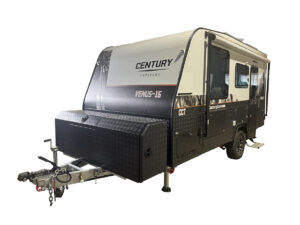
Century Caravans builds the Venus range across compact and touring-friendly sizes, with both on-road and off-road options. The most useful way to think about towing suitability isn’t just the model name. It’s how the caravan’s ATM and towball load fit your vehicle, once your vehicle is loaded for the trip you actually want to take.
In practice, many buyers shortlist in two stages:
Stage 1: Match the caravan size to your towing reality
If you’re towing with a vehicle that has limited payload headroom (for example, you often travel with multiple passengers, or you have heavy accessories fitted), you’ll generally feel more comfortable starting the search around compact, touring-friendly caravans.
If you’re towing with a setup built for heavier touring (more payload headroom, higher towball download limit, and a strong combined-weight allowance), you’ll have more flexibility to consider larger vans and stronger off-grid packages.
Our most popular caravans, such as the Venus 16 On Road and Venus 16 Off Road, are also the most versatile, as they provide more living space without too much compromise on towing.
Stage 2: Decide how you actually travel (parks vs off-grid vs mixed roads)
This is where on-road vs off-road choices become clearer. Off-road touring features and off-grid upgrades are fantastic for the way many Australians travel, but they also change real-world weight and loading. That doesn’t make them “bad”; it just makes it even more important to confirm your numbers early.
A practical next step: once you’ve shortlisted one or two Venus models, compare:
- The model’s ATM
- The expected towball load
- Your vehicle’s towball download limit
- Your vehicle’s payload headroom with your usual passengers and gear
If you’d like, we can also help you choose between a compact touring option and a longer “home base” touring setup based on your tow vehicle and travel style.
Read more about the best caravan parks in Australia.
Common questions
If my car can tow 3,500 kg, can it tow any caravan under 3,500 kg?
Not necessarily. You may still exceed towball download limits, payload/GVM, rear axle limits, or GCM, especially once passengers and touring gear are added.
What’s the biggest number I should care about: ATM or towball weight?
Both matter, but towball weight is often the surprise limiter because it’s carried by the vehicle and reduces available payload.
Do I need a weight distribution hitch?
It depends on the vehicle, the caravan, and the setup. Some combinations benefit, some don’t, and some manufacturers have specific guidance. If you’re unsure, get advice from a qualified towing specialist and follow the vehicle manufacturer’s recommendations.
What’s the best way to know for sure?
A weighbridge check is the most reliable method, especially before a long trip or if your combination is close to limits.
Final takeaway
You can answer “Can I tow a caravan?” confidently if you stop treating it as one number and start treating it as a system:
- understand the caravan’s loaded weight (ATM)
- respect towball weight as a vehicle load
- check vehicle payload/GVM headroom
- confirm combined weight (GCM)
- validate with a weighbridge if you’re touring seriously
When those pieces align, towing becomes less stressful, and choosing the right caravan becomes much clearer.