



How to Load a Caravan Safely (Weight Distribution & Stability)
If you’ve ever looked at a caravan spec sheet and thought, “Okay… but what do these numbers actually mean for towing?” you’re not alone. In Australia, most weight confusion comes down to four terms that sound similar but mean very different things: Tare, ATM, GTM, and towball weight.
They’re not just “paper specs”, either. These weights affect how the caravan behaves behind the car, whether it’s stable at highway speeds, how it handles bumps and corrugations, and whether you’re operating within your vehicle’s limits. Understand them properly, and you’ll shop smarter, pack better, and tow with more confidence.
This guide breaks it down in plain language and shows you how the numbers connect in real life.
Start with the simple picture: what are we weighing?
When we talk about “caravan weight”, we’re really weighing the same caravan in different situations:
- Tare is the van in its baseline, empty-ish state.
- ATM is the van at its maximum allowed loaded weight.
- GTM is how much weight is sitting on the caravan’s wheels (through the axle/s).
- Towball weight is how much weight is pushing down on your tow ball.
Same caravan. Different “snapshots”. Once you see it like that, the whole system becomes easier.
Tare weight: the caravan before you move in
Tare weight is the caravan’s weight as supplied by the manufacturer, usually without your personal gear. Exactly what’s included in Tare can vary between brands (and sometimes between build options), so the safest mindset is:
Tare is a starting point, not your real touring weight.
Why? Because real touring weight includes everything you add: clothes, food, water, batteries, bikes, tools, extra accessories, and all the “just in case” items that sneak into front boots and tunnels.
Tare matters because it gives you a baseline, but it doesn’t tell you if you can tow the van once it’s packed for a trip.
ATM: the number that sets the ceiling
ATM stands for Aggregate Trailer Mass. In practical terms, it’s the maximum legal weight the caravan is allowed to be when fully loaded. Think of ATM as the hard limit: the van’s total mass when it’s ready to travel, including everything inside it, and including the towball weight.
There’s a simple relationship worth remembering: ATM = Tare + Payload
Where payload (in caravan terms) is the amount of “stuff” you’re allowed to add to the van before you hit the limit. If you’re a buyer, payload is one of the most important numbers because it decides whether your caravan can comfortably carry your touring lifestyle.
A caravan with a small payload can feel fine on paper, but frustrating in the real world, because you run out of legal carrying capacity faster than you expect.
GTM: what the caravan’s wheels are carrying
GTM stands for Gross Trailer Mass. It’s the maximum mass supported by the caravan’s wheels (through the axle/s) when it’s hitched to the tow vehicle. This is the one people often miss. But it matters because a caravan can be under its ATM and still overload the axle if the load distribution is poor.
A simple way to visualise GTM is:
- Put the caravan on a scale under the wheels while it’s hitched to the car
- The reading under the wheels is essentially the “on-axle” part of the load
- The missing piece is sitting on the tow ball
Which leads to the connection many people find useful:
Towball weight ≈ ATM − GTM (Approximate because real-world scales and loading can vary, but conceptually it’s the relationship.)
Towball weight: the “hidden” weight your vehicle must carry
Towball weight is the downward force the caravan applies to the tow ball. It is part of the caravan’s total mass (ATM), but it is carried by the tow vehicle. This is where a lot of towing setups go wrong, because towball weight doesn’t just “exist”, it consumes your vehicle’s own capacity.
Here’s the practical consequence:
Towball weight counts toward your tow vehicle’s payload and its axle loads.
So if your vehicle is already carrying passengers, a canopy, drawers, a fridge, recovery gear, and luggage, you can run out of vehicle payload before you realise it, even if the towing capacity number looks fine.
Towball weight also affects stability. Too light and you can increase sway risk; too heavy and you can overload the rear axle or cause poor steering/braking feel. The “right” towball weight is less about chasing a perfect percentage and more about staying within limits and distributing load sensibly.
How these numbers connect (a realistic example)
Let’s make the relationships tangible without turning this into a maths class.
Imagine a caravan has:
- Tare: 2,100 kg
- ATM: 2,700 kg
That means the payload is:
- Payload = ATM − Tare = 600 kg
That 600 kg includes everything you add: your gear, food, optional accessories, water, and any upgrades that weren’t part of the tare configuration.
Now imagine when hitched and loaded, the caravan’s GTM is 2,520 kg. That implies the towball weight is roughly:
- Towball ≈ ATM − GTM = 2,700 − 2,520 = 180 kg
That 180 kg is now pressing down on your tow vehicle, affecting its payload and axle load. This is why it’s totally possible to be “under tow rating” but still be overweight in the wrong place.
How does this apply to the Venus range caravans
Once you understand the language of weights, the next step is applying it to real caravans, because that’s where buyers go from “I get it” to “I can actually compare models sensibly”.
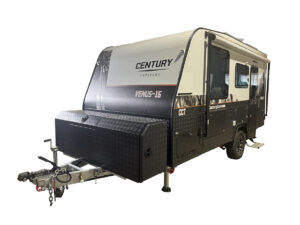
At Century Caravans, our Venus range is designed around touring practicality: compact options that stay easy to manage, plus larger vans that give you more “home base” comfort while still supporting the way Australians actually travel (a mix of parks, free camping, and plenty of miles in between).
Here’s how the key weight numbers show up across the Venus models people most commonly compare:
- Venus 11 Plus (On-Road, 11ft): ATM 1800kg
- Venus 13 (On-Road, 13ft): ATM 1900kg
- Venus 14 (On-Road, 14ft): ATM 2500kg
- Venus 16 (On-Road, 16ft): Tare 1900kg, Towball 150kg, ATM listed as 2400kg (spec table) / 2500kg
- Venus 16 (Off-Road, 16ft): Tare 1900kg, Towball 150kg, ATM listed as 2400kg (spec table) / 2500kg
- Venus 19 (On-Road, 19ft): Tare 2260kg, Towball 170kg, ATM 3000kg
- Venus 19 (Off-Road, 19ft): Tare 2260kg, Towball 170kg, ATM 3000kg
A few important “real world” points that help buyers use those numbers correctly:
First, the model name isn’t the whole story. Options change weights.
Off-grid upgrades, extra batteries, added accessories, and even small spec changes can alter tare and therefore your usable payload. That’s why the best habit is to treat published weights as a guide and confirm the final build spec before purchase.
Second, water is one of the biggest hidden weight shifts.
Fresh water adds weight fast (roughly 1L = 1kg). So a larger touring setup with big water capacity can feel very different depending on whether you travel with full tanks or refill more often.
Third, towball weight is the number most people forget to plan around.
For the models where towball weight is listed, remember that downward load is carried by the tow vehicle and counts toward the vehicle’s payload and rear axle limits. Even when your tow rating looks fine, towball weight can be the bottleneck.
If you’re comparing Venus models, the smartest way to shortlist isn’t “what length do I like?” It’s: What’s the ATM? How much payload do I realistically need? Can my vehicle safely carry the towball load once the car is packed with people and gear?
How to check if your setup is safe (without getting overwhelmed)
If you’re shopping or preparing for your first big trip, here’s the order that keeps it simple.
1) Find the caravan’s compliance plate / spec sheet numbers
You’re looking for:
- ATM
- Tare
- GTM
- Towball weight (sometimes listed as a typical or ball load figure)
If you’re comparing caravans, treat payload as a first-class spec, not an afterthought.
2) Do a “reality check” on payload
Ask yourself: will your travel style fit inside the payload? People often underestimate:
- Water (especially if travelling with full tanks)
- Added batteries / solar upgrades
- Front boot and tool storage
- Bikes on the rear
- Outdoor kitchens and accessory packages
Even a well-built caravan can become annoying if payload forces you to constantly compromise.
3) Compare against the tow vehicle’s limits (not just “towing capacity”)
Most people look at towing capacity first because it’s the loudest number, but it’s not the only one that matters. In real life, you also want to respect:
- Vehicle payload (GVM headroom)
- Rear axle load
- Maximum towball download
- Gross Combination Mass (GCM), if applicable to your vehicle
That’s why a “can I tow it?” check is more than a single number. It’s a whole system.
4) Load distribution matters as much as total weight
Two caravans can weigh the same but tow very differently depending on where the weight sits. As a rule of thumb:
- Heavy items low and close to the axle tend to behave better
- Too much weight at the extreme front or rear can create handling issues
- Rear bike racks and heavy storage behind the axle can change the towing feel quickly
If you ever feel the van is “pushy”, “floaty”, or twitchy in crosswinds, weight distribution is one of the first things to check.
The most common misunderstandings (and how to avoid them)
The internet is full of weight advice that sounds confident but leaves out key details. These are the big ones to watch.
“If my car can tow 3,500 kg, I’m fine.”
Not necessarily. You can hit payload limits, towball download limits, or axle load limits well before the tow rating becomes the problem.
“Tare is what it weighs.”
Tare is rarely what it weighs for travel. Your real touring weight is usually much closer to ATM than you think, especially for longer trips.
“Hybrid/off-road caravans are always heavier.”
Some are, some aren’t. Build strength, suspension choice, and off-grid packages can add weight, but design efficiency and layout matter too. The smarter way to compare is to look at ATM, payload, and how you’ll use it, rather than assuming a category tells you everything.
A quick note for buyers: weights are only half the story
Caravan weights tell you what’s allowed. They don’t automatically tell you what will feel best on the road.
For touring comfort, especially on mixed roads, it’s worth paying attention to the foundations that influence towing behaviour:
- Chassis and drawbar design
- Suspension quality and suitability
- Coupling choice
- Clearance and protection
- Sealing and touring durability
Weights are the gatekeeper. Build design is what shapes the experience.
FAQ
What’s the difference between ATM and GTM?
ATM is the caravan’s maximum total loaded weight. GTM is the maximum weight supported by the caravan’s wheels when hitched. The difference is effectively the towball download component.
Is towball weight included in ATM?
Yes, towball weight is part of the caravan’s total mass. But it’s carried by the tow vehicle and affects your vehicle’s payload and axle loads.
How do I calculate the payload for a caravan?
Payload is generally ATM − Tare. It represents how much you can add (gear, water, accessories, options) before reaching the ATM limit.
Why does payload matter so much?
Because it determines whether the caravan can legally and practically carry your touring setup. If the payload is tight, you may be forced to travel with less water, fewer accessories, or constantly rethinking what you pack.