



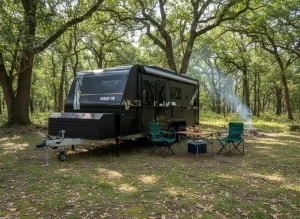

How to Load a Caravan Safely (Weight Distribution & Stability)
Most towing problems don’t start with the caravan model. They start with the way the caravan is loaded.
Two caravans can weigh the same and tow completely differently depending on where the weight sits. That’s because towing stability isn’t just about total mass; it’s about balance. If the load is poorly distributed, the caravan can feel pushy on brakes, unsettled over bumps, or nervous in crosswinds, even when you’re technically “within limits”.
The goal of safe loading is simple: keep the combination stable, predictable, and within the limits of both the caravan and the tow vehicle. This guide explains the principles that matter most in a practical way you can apply before every trip.
(If you want the fundamentals first, our guides on ATM vs Tare vs GTM and towball weight pair perfectly with this page.)
Why weight distribution matters more than most people realise
When you tow a caravan, you’re not just pulling weight. You’re managing a moving lever system. The caravan pivots around its axle line. Add weight forward of the axles, and you increase the towball load. Add weight behind the axles, and you reduce towball load and change the way the caravan responds to bumps and steering input.
That’s why “it feels fine around town” can turn into “it feels sketchy at 95 km/h”. Stability issues usually show up at speed, in wind, when trucks pass, or when the road surface becomes uneven.
A well-loaded caravan tends to feel calm and predictable: it tracks straight, brakes smoothly, and doesn’t demand constant steering corrections. A poorly loaded one tends to make you work, and towing should never feel like a wrestling match.
Start with the non-negotiables: weights and limits
Before we talk packing tips, it’s worth grounding this in the limits that actually matter. Safe loading isn’t only about “feel”. It’s also about staying legal and mechanically safe.
On the caravan side, the key constraints are:
- ATM (maximum loaded caravan weight)
- GTM (maximum load supported by the caravan’s wheels)
- Tyre load ratings (often overlooked)
On the vehicle side, the key constraints are:
- Maximum towball download
- Vehicle payload/GVM headroom
- Rear axle load (often the practical limiter)
- GCM (combined vehicle + trailer limit)
If your setup is close to any of these, the best move is to verify with a weighbridge. Guesswork feels cheap until it becomes expensive.
The safest loading principle in one sentence
If you only follow one rule, make it this:
Keep heavy items low and close to the axle line, and avoid heavy weight at the extreme front or extreme rear.
That single idea solves a surprising number of real-world towing issues.
“Low” reduces the van’s tendency to roll and sway. “Close to the axle” reduces leverage effects that change towball weight and stability. “Avoid extremes” prevents the caravan from behaving like a pendulum.
The two loading mistakes that cause most towing drama
1) Loading the rear because it “seems easier”
Rear loading is the classic trap. It’s tempting because it’s convenient: bikes on a rear rack, heavy tubs in the back storage, extra gear shoved behind the axle because there’s space.
But weight at the rear can:
- reduce towball weight (sometimes too much)
- increase sway risk
- amplify “pendulum” effects over bumps
- make the caravan feel like it’s steering the car in crosswinds
Even if you’re under your ATM, rear-heavy loading can make towing feel unsettled.
2) Overloading the front boot because it “feels secure”
The other trap is the front boot. It’s sturdy, accessible, and it feels like the logical place for heavy items: generators, toolboxes, jerry cans, recovery gear. Front loading tends to increase towball weight quickly. Towball weight is carried by the tow vehicle, so too much can:
- reduce available payload
- overload the rear axle
- cause rear sag and light steering feel
- compromise braking confidence
A caravan can be “within its own limits” but still create a towing setup that’s wrong for your vehicle.
How to pack a caravan for stable towing (a practical method)
Instead of packing randomly and hoping it works out, use this method. It’s simple, repeatable, and it keeps the “systems” thinking in place.
Step 1: Pack the fixed “must-haves” first
Start with the items that are hard to move:
- installed batteries, toolboxes, spare wheels
- fixed storage contents you always carry
- major accessories that live in the van
These establish your baseline. Once those are in place, you can fine-tune everything else.
Step 2: Put the heaviest portable items near the axle line
This is where you place items like:
- tools
- canned food
- cooking gear
- heavier camping items
Aim for storage compartments that sit low and roughly around the axle area. This reduces leverage and keeps the van calm.
Step 3: Treat the front boot as “limited capacity”
Use it, but be deliberate. Put lighter bulky items up front rather than dense heavy loads. If you must carry something heavy in the front boot, assume towball weight will rise and plan around it.
Step 4: Avoid “heavy at the rear” unless you’re correcting towball weight
If you’re trying to reduce towball weight, the temptation is to add weight to the rear. That can work in small amounts, but it’s also the easiest way to introduce sway.
A safer approach is usually:
- shift weight from front → midship
- move weight from high → low
- reduce unnecessary rear loads
- consider rethinking bike/storage solutions (especially if they sit far behind the axle)
The rear should be the last place you try to “solve” balance.
Step 5: Keep high storage for light items only
Upper cupboards are perfect for clothing, bedding, and light items. They are not ideal for heavy items because height increases the van’s tendency to roll and sway. If the van feels top-heavy, the fix is often as simple as moving weight down.
Water: the hidden weight shift that changes your towing feel
Water is freedom, and also one of the biggest sources of weight movement.
Because water is heavy and tank location matters, towing can feel different depending on whether you travel with:
- full tanks
- half tanks
- empty tanks and refilling more often
If your caravan feels stable one trip and slightly unsettled the next, check the difference in water levels. It’s one of the fastest “mystery solving” habits you can build.
How to use towball weight as your loading compass
Towball weight is a powerful reality check because it reflects whether your loading has become front-heavy or rear-heavy.
If the towball weight is too high for your vehicle:
- you usually need to move weight rearwards towards the axle, not to the extreme rear
- reduce heavy items in the front boot
- shift portable heavy items to midship storage
If the towball weight is too low (and the van feels twitchy):
- check for heavy rear loads
- move weight forward towards the axle
- remove or reduce rear rack loads if possible
The best part is this: towball weight can be measured. When something is measurable, it becomes manageable.
Signs your loading needs attention
Sometimes the caravan tells you you’ve packed it badly. These are common signals.
You may be too front-heavy if:
- the rear of the vehicle squats noticeably
- steering feels light
- braking feels less confident
- the car feels “nose up”
You may be too rear-heavy if:
- the caravan feels twitchy or nervous at speed
- sway appears in crosswinds or when trucks pass
- the van feels like it’s steering the car
- the instability gets worse as speed increases
If you experience sway, slow down smoothly and safely, and don’t try to “steer out of it” aggressively. Then reassess loading and distribution before you continue.
A note on weight distribution hitches and suspension upgrades
Some towing setups benefit from a weight distribution hitch (WDH) or suspension assistance. Some do not, and some vehicles have manufacturer guidance that limits WDH use.
The important point is that towing hardware can help, but it doesn’t replace good loading. If the caravan is rear-heavy or your towball weight is outside what your vehicle can comfortably carry, accessories won’t magically fix the underlying physics.
The best order is:
- get loading right
- verify weights
- then consider towing hardware if needed for comfort and stability
How this applies to Century Caravans (Venus range)
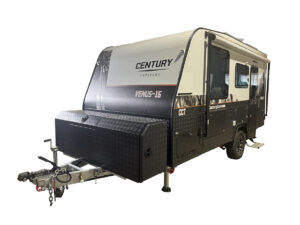
Century Caravans’ Venus range is built for touring practicality. For many buyers, the attraction is the balance between comfort and towing manageability. But regardless of whether you choose a compact touring size or a longer “home base” layout, the day-to-day towing feel still comes back to the same principles: stay within your limits, keep heavy items low, and avoid extremes at the front and rear.
For example, if you’re setting up for longer off-grid trips (extra batteries, gear, full water, outdoor cooking equipment), the way you distribute that load matters as much as the specs themselves. A well-loaded van feels calm and predictable, and that’s the experience you want, especially when you’re touring Australia’s varied roads.
If you’re comparing Venus models, the most helpful habit is to think beyond the brochure and plan for your real touring routine:
- Do you carry bikes? Where do they sit relative to the axle?
- Do you travel with full tanks or refill often?
- Do you load heavy items into the front boot because it’s convenient?
- How much gear lives in the vehicle versus in the caravan?
Answer those questions early, and you’ll not only tow more safely. You’ll also choose a caravan that fits the way you travel.
The best “final check” before a big trip
If you’re heading off on a longer tour, or if you’re new to towing, here’s the calmest way to remove uncertainty:
- Load the caravan how you actually travel
- Measure towball weight (or go to a weighbridge)
- Confirm you’re within ATM/GTM and the vehicle’s payload/towball limits
- Adjust packing while it’s easy (before you’ve left town)
It’s one of those small steps that make the whole trip feel better.
FAQ
Does packing heavier items at the back reduce towball weight?
Often yes, but it can also increase sway risk. A safer approach is usually shifting weight from the front to storage closer to the axle rather than placing heavy items at the extreme rear.
Should I travel with full water tanks?
It depends on your route and refilling options. Water adds weight quickly and can change towball weight depending on tank location. Many travellers carry what they need between refills rather than always travelling full.
What’s the safest way to know if I’m loaded correctly?
Measure it with a towball scale and/or weighbridge. It removes guesswork and helps you adjust load distribution with confidence.