






How to Load a Caravan Safely (Weight Distribution & Stability)
If you’ve been researching caravans for more than five minutes, you’ve probably seen people talk about tow ratings like they’re the whole story. Then you’ll hear someone say, “Yeah, but what’s the towball weight?” and suddenly it feels like there’s another rulebook you didn’t get.
Towball weight matters because it sits right at the intersection of safety, stability, and legality. It affects how your car steers and brakes, how stable the caravan feels at highway speed, and whether your vehicle still has enough payload left once you add passengers, luggage, and accessories.
In simple terms:
Towball weight is the downward force the caravan applies to your tow ball.
It’s part of the caravan’s overall weight, but it is carried by the tow vehicle, not the caravan’s axles.
That one detail is why towball weight catches so many people out. You can have a vehicle with a strong towing capacity and still run into trouble if towball weight, plus everything else in the car, pushes you over your limits.
Why towball weight matters more than most people expect
There are two ways towball weight impacts you, and both show up fast when you’re actually towing.
1) It uses up your vehicle payload (often the real bottleneck)
Your vehicle has a maximum allowed loaded weight (GVM). The difference between your vehicle’s empty weight and its GVM is your payload, or the “headroom” you have for everything you carry.
Towball weight sits inside that payload. So do:
- passengers
- luggage
- accessories (canopies, drawers, roof racks, bull bars)
- recovery gear, fridge, and the touring bits that live in the car
This is why people sometimes discover the uncomfortable truth: they’re within their tow rating, but out of payload. And payload is not optional.
2) It changes how the whole combination behaves on the road
Towball weight affects the balance of the caravan and the attitude of your tow vehicle.
- Too much towball weight can overload the rear axle, cause rear sag, and make steering feel lighter.
- Too little towball weight can make the caravan feel “floaty” and increase the likelihood of sway, especially in crosswinds or when being passed by trucks.
Most towing issues people describe as “the van feels nervous” are, at least partly, a weight distribution and towball load problem.
Towball weight vs ATM vs GTM (how the numbers relate)
This becomes much easier when you see the relationship:
- ATM is the caravan’s maximum allowed loaded weight.
- GTM is the maximum weight the caravan’s wheels can carry when hitched.
- Towball weight is the part of the caravan’s load that sits on the vehicle.
A useful way to think about it is:
ATM ≈ GTM + Towball weight (Conceptually true, and close in practice.)
So towball weight isn’t an “extra” that comes from nowhere. It’s simply where part of the caravan’s weight is being carried on your vehicle instead of on the caravan axles.
What makes towball weight go up or down?
Towball weight isn’t fixed. It changes depending on how the caravan is loaded.
Picture the caravan like a seesaw, with the axles acting as the pivot point. Move the weight forward of the axles, and you usually increase the towball weight. Move the weight behind the axles, and you usually decrease it, sometimes too much. Here are the most common real-world causes of towball changes:
Water and tank locations
Water is heavy (roughly 1L = 1kg). If you fill a tank forward of the axles, the towball weight tends to rise. If it’s behind, it may fall. This is why two trips with the same van can tow differently: one trip you carried full fresh water, the next you didn’t.
Front storage habits
The front boot is convenient, and it’s also the easiest way to unintentionally overload towball weight with generators, toolboxes, jerry cans, or heavy recovery gear.
Rear racks and “just put it at the back” packing
Bikes, spare wheels, extra boxes, and heavy items at the extreme rear can reduce towball weight and make towing feel less stable. It can also increase “pendulum” effects over bumps.
Upgrades and accessories
Extra batteries, solar upgrades, toolboxes, air conditioners, and other options can move the numbers around. Two caravans of the same model can end up with different towball figures depending on build and options.
The takeaway: towball weight is not just a spec sheet number, it’s something your packing decisions influence.
“What should towball weight be?” (the sensible way to think about it)
People often want a single perfect target. In practice, towball weight is about balancing three things:
- Stability (enough downward load to help the caravan track properly)
- Vehicle limits (towball download limit, payload/GVM, rear axle)
- How you’re actually touring (water, gear, passengers, accessories)
You’ll often hear broad “rule of thumb” ranges mentioned, but it’s smarter to treat those as a starting point and then work backwards from your actual constraints. If your vehicle’s towball download limit or payload headroom is tight, your workable towball range is simply smaller, regardless of what the internet says.
If you’re not sure where to start, the safest approach is:
- confirm your vehicle’s max towball download,
- confirm your vehicle’s payload headroom for your usual passenger load, then
- measure the caravan’s actual towball weight when loaded for a trip.
That gives you facts, not forum anxiety.
How to measure towball weight (properly)
If you want certainty, you measure it. There are a few practical ways to do that.
The simplest: a towball scale
A purpose-built towball scale is straightforward, repeatable, and safer than improvised methods. If you tow often, it’s a worthwhile tool.
The best overall: a weighbridge
A weighbridge can tell you more than towball weight — it can also show axle loads and the full combination weight. That’s especially helpful if you’re touring long distances or running close to limits.
The DIY approach (use caution)
Some people use a bathroom scale with a lever setup. It can work, but it’s easy to do incorrectly and can be unsafe if the caravan isn’t stable or if the setup slips. If you go down this path, take safety seriously: stable ground, chocked wheels, a reliable support arrangement, and no hands/feet anywhere they could be pinned if something shifts.
If you’re new to towing, a towball scale or weighbridge is the better first step.
Signs your towball weight (or load distribution) isn’t right
Towball weight problems usually introduce themselves through “feel”. The combination starts telling you something.
If your towball weight is too heavy for your setup, you might notice:
- the rear of the vehicle squatting noticeably
- headlights pointing upward
- steering feels lighter than normal
- braking feels less confident
- rear axle load risks becoming the real limiter
If your towball weight is too light (often from heavy rear loading), you might notice:
- caravan feels twitchy at speed
- sway that appears in crosswinds or when trucks pass
- a sensation that the caravan is steering the car
- instability that gets worse with speed
Not every handling issue is towball weight, but it’s one of the first things worth checking because it’s measurable and fixable.
How to adjust towball weight without “guessing”
If you measure your towball weight and it’s outside what your setup can handle, the fix is usually about where the weight sits, not simply “carry less”. A few principles that consistently help:
Keep heavy items low and close to the axle line
This tends to improve stability and reduce extremes at the front and rear.
Avoid stacking heavy weight at the very back
Rear-mounted bikes and storage can look harmless until you feel how the van behaves on the road.
Be intentional with front storage
Front boots are where the towball weight creeps up. If you’re adding something heavy up front (like a generator), assume it will push towball weight higher and plan around it.
Treat water as a big lever
If your towing feels different trip to trip, think about tank levels and when you’re towing with full water versus refilling more often.
If you’re close to limits and still want a stable setup, it’s worth speaking with a towing specialist about your specific combination and whether your suspension, hitch configuration, and load distribution are working with you rather than against you.
How this applies to the caravans Century Caravans sells (Venus range)
Towball weight is one of those topics that becomes much clearer once you look at real models because buyers rarely ask “what’s towball weight?” in isolation. They’re really asking, “What does this mean for the vans I’m actually considering?”
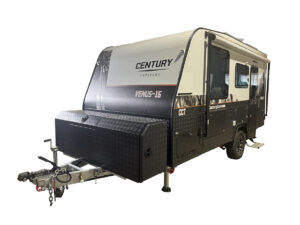
Century Caravans’ Venus range covers compact touring up to longer “home base” layouts, in both on-road and off-road variants. As a guide:
- Venus 16 On Road and Venus 16 Off Road lists a towball weight of 150kg and ATM 2500kg.
- Venus 19 On Road and Venus 19 Off Road lists a towball weight of 170kg and ATM 3000kg.
- Venus 11 Plus, Venus 13, and Venus 14 list ATMs of 1800kg, 1900kg, and 2500kg, respectively (towball weight can vary depending on build and loading).
Two important notes if you publish those figures on the page:
- Options and loading can change towball weight. Off-grid upgrades, accessories, and how you pack the caravan all influence the real number.
- Towball weight must suit the tow vehicle, not just the caravan. A towball figure that works comfortably for one vehicle can be a tight fit for another, depending on payload headroom and towball download limits.
If you’re shopping the Venus range, towball weight is one of the clearest ways to match caravan choice to tow vehicle reality, especially once you factor in how many passengers you usually carry and how “touring-heavy” your vehicle setup is.
Read our complete guide about ATM vs Tare vs GTM, and whether I can tow a caravan.
Common questions about towball weight
Is towball weight included in ATM?
Yes. Towball weight is part of the caravan’s total loaded mass (ATM). The difference is that the towball weight is carried by the tow vehicle rather than the caravan axles.
If I’m under my tow rating, can towball weight still be a problem?
Absolutely. Towball weight can push you over your vehicle’s towball download limit, reduce your available payload, and overload the rear axle, even if towing capacity looks fine.
Does adding bikes to the rear affect towball weight?
Often, yes. Weight at the rear can reduce towball weight and change how stable the caravan feels at speed. It can also introduce “pendulum” effects on bumps.
What’s the best way to know my real towball weight?
Measure it with a towball scale or use a weighbridge for the most complete picture.
The calm takeaway
Towball weight isn’t something to fear. It’s something to understand and manage.
If you treat towing as a system, towball weight becomes one of the most useful “truth-tellers” you have. It tells you how your caravan is balanced, how much load your vehicle is really carrying, and why a setup that looks fine on paper might feel wrong on the road.
And once you’ve got it right, towing usually becomes quieter, steadier, and far less stressful.