

Venus 13 vs Venus 14: Comparing Layout, Space and Features
Caravan insurance is one of those ownership costs people often research after they’ve fallen in love with a caravan. By then, they’re already thinking about the layout, the tow vehicle, the weekend trips, the off-grid setup and where the first big journey might be.
But insurance is worth thinking about earlier, not because it should scare you away from buying, but because it helps you understand the full cost of owning a caravan properly.
In Australia, caravan insurance can vary widely. A small touring caravan, a high-value off-road caravan, a camper trailer, and a luxury van with extensive accessories can all attract very different premiums. Some consumer guides place basic camper trailers in the few-hundred-dollar-per-year range, while mid-range and higher-value caravans can sit anywhere from several hundred to well over a thousand dollars per year, depending on the policy, value, storage, usage and location.
So the more useful question is not simply, “How much is caravan insurance?” It’s: “What affects the premium, and what should I check before I buy a caravan?”
Is caravan insurance required in Australia?
Caravan insurance is generally not legally required in the same way registration and roadworthiness rules may apply. However, that does not mean it is something to ignore.
Caravan insurance is not legally required to tow a caravan, but it can be useful if your caravan is involved in an accident or your contents are stolen. Your car insurance generally covers your car, not the caravan itself, if you have an accident while towing.
That distinction matters. A caravan is not just “something behind the car”. It is a high-value touring asset with its own structure, appliances, fittings, contents, annexe equipment and sometimes off-grid systems. If something happens to it, you want to understand what is and is not covered before you need to make a claim.
This is why many caravan buyers treat insurance as part of the pre-purchase research process, alongside towing weights, layouts, warranties and servicing.
What does caravan insurance usually cover?
The exact cover depends on the insurer and the policy, so it is important to read the Product Disclosure Statement carefully. Broadly, caravan insurance in Australia may cover things like accidental loss or damage, theft, fire, storm, flood, and legal liability, depending on the policy type and exclusions. Caravan insurance is a stand-alone policy that may provide cover for loss or damage to the caravan and contents, as well as legal liability for property damage caused by the use of the caravan.
Some specialist caravan insurers may also cover events such as hail, storm, cyclone, flood, theft, attempted theft, fire and accidental loss or damage.
The keyword is “may”. Insurance policies differ. One policy might include certain content limits automatically; another might require you to add content coverage. One might treat annexes, awnings, solar equipment or accessories differently. One might have conditions around off-road use, storage or unattended theft.
So instead of assuming “caravan insurance covers everything”, it is better to ask practical questions:
Is the caravan covered while being towed?
- Is it covered when stored at home?
- Are contents, appliances and accessories included?
- What happens if it is damaged by storm or hail?
- Are annexes, awnings and external equipment covered?
- Are there limits around off-road or remote travel?
- Is the policy agreed value or market value?
- What exclusions apply?
That last question is the one buyers often skip, but it is often the most important.
Why caravan insurance costs vary so much
Caravan insurance does not have one neat average because premiums are built around risk. Insurers look at the caravan, the owner, the storage situation and the way the caravan is used.
A compact on-road caravan stored securely and used occasionally is a very different risk profile from a high-value off-road caravan with accessories, off-grid upgrades and frequent long-distance travel.
The main factors usually include the caravan’s value, age, usage, storage location, security, claims history, excess, travel regions and the level of cover selected.
In plain English: the more expensive the caravan is to repair or replace, and the more exposed it is to theft, weather, road damage or frequent use, the more the policy may cost.
Caravan value: the biggest starting point
The value of the caravan is one of the clearest drivers of insurance cost. A newer, more expensive caravan generally costs more to insure than an older or simpler model because the potential repair or replacement cost is higher.
This is especially relevant when comparing caravans with different specifications. A van with a premium off-grid system, larger battery capacity, solar, inverter, upgraded appliances or specialised off-road components may have a higher insured value than a simpler touring build.
That does not mean a better-equipped caravan is a bad choice. It just means the true cost of ownership should include more than the purchase price.
When you are comparing caravans, it is sensible to ask for an insurance quote based on the model and approximate final build value before you commit.
On-road vs off-road caravans: does it affect insurance?
It can.
An off-road caravan may have stronger foundations, upgraded suspension, off-grid power, additional hardware and a higher purchase price than a more straightforward on-road touring caravan. Depending on the insurer, that can influence the premium because the insured value and repair complexity may be higher.
There is also the question of how you use it. If you plan to travel further, stay off-grid more often, take unsealed roads and carry more equipment, your insurance needs may be different from someone who mostly stays in established parks on sealed routes.
This is where pre-purchase research becomes useful. You are not just comparing “on-road vs off-road” as a lifestyle choice. You are also comparing:
- Purchase price
- Towing requirements
- Servicing and maintenance expectations
- Storage needs
- Insurance considerations
- How the caravan will actually be used
For a buyer choosing between an on-road and off-road build, this is a good moment to slow down and compare the full ownership picture, not just the model brochure.
Storage and security can change the premium
Where and how you store your caravan can matter. Some insurers specifically ask whether the caravan is kept at home, in a storage facility or on the street, because storage affects theft and damage risk. Where and how a caravan is stored is an important consideration when getting caravan insurance.
Security can also play a role. Wheel clamps, hitch locks, GPS trackers, locked garages, secure yards and monitored storage may all influence how an insurer assesses risk.
This is worth thinking about before you buy because not everyone has space to store a caravan at home. If you need paid storage, that cost should sit alongside insurance, registration and servicing in your ownership budget.
Usage matters: weekend van or regular touring setup?
Insurers may also look at how often and how far you travel. A caravan used occasionally for short weekends may not be assessed the same way as a caravan used for long touring loops, extended free camping or frequent interstate travel.
Again, that does not mean you should avoid using the caravan properly. The whole point is to travel. But your insurance should match your real usage.
If your plan is to tour Australia, spend time away from powered sites, carry extra gear and explore regional areas, say that when you quote. You want a policy that reflects the way you actually intend to use the van.
Contents, accessories and off-grid equipment
Caravans are rarely empty shells. Over time, they collect gear: hoses, chairs, portable appliances, cooking equipment, bedding, tools, annexe equipment, recovery gear and more.
Then there are fitted or semi-fitted accessories: solar panels, lithium batteries, inverters, air conditioning, awnings, external kitchens, upgraded suspension components, cameras and security systems.
Some policies include limited contents cover. Others require optional upgrades. Some accessories may need to be listed or included in the insured value. Youi, for example, notes that gear inside the caravan may be covered up to certain limits under some policy types, with options to upgrade contents cover.
This is one of the most important areas to check carefully because many owners underestimate the value of what they carry.
A simple exercise helps: imagine everything inside and attached to the caravan disappeared tomorrow. What would it cost to replace? That number is often higher than expected.
Agreed value vs market value
Another key insurance decision is whether the policy is based on agreed value or market value.
Agreed value means you and the insurer agree on the insured value when the policy starts. This can give more certainty, but the premium may be different depending on the value chosen and insurer criteria.
Market value means the insurer determines the caravan’s value at the time of loss, based on the market and policy terms. This may be cheaper in some cases, but it can feel less predictable.
There is no universal “best” option. The right choice depends on your caravan, budget, risk tolerance and how much certainty you want if the caravan is written off.
For a new or near-new caravan, many buyers prefer to at least compare both options before deciding.
Excess: cheaper premium now, bigger cost at claim time
A higher excess can reduce your premium, but it also increases what you pay when you make a claim.
This is not a trick; it is just a trade-off. If you choose a higher excess, make sure it is an amount you would be comfortable paying quickly after an accident, theft or storm event.
The cheapest annual premium is not always the best policy. A good policy is one that balances affordability, coverage and claim-time practicality.
How to compare caravan insurance quotes properly
The best way to compare insurance is not to chase the cheapest number first. Start by making sure the quotes are actually comparable.
Use the same details for each quote:
- caravan make, model and year
- purchase price or insured value
- accessories and modifications
- storage location
- usage pattern
- contents amount
- excess level
- agreed or market value preference
Then read the differences.
One policy may be cheaper because it has lower contents limits. Another might exclude something you assumed was covered. Another may handle off-road recovery, annex damage, storm damage or storage differently.
A proper comparison takes a little longer, but it prevents the classic mistake: choosing the cheapest premium and discovering the gaps only when something goes wrong.
How does this fit when you’re considering a caravan from Century Caravans
Insurance is not usually the reason someone buys a caravan. But it is one of the details that helps you buy with confidence.
If you are comparing Century Caravans models, the insurance conversation naturally sits alongside the bigger pre-purchase questions:
- Do you want an on-road caravan for established touring routes?
- Do you want an off-road build for rougher roads and more remote camps?
- How much off-grid capability do you need?
- What tow vehicle are you using?
- Where will you store the caravan?
- What is your realistic ownership budget?
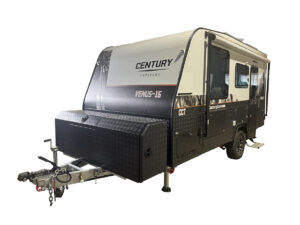
The Venus range includes both compact touring options and larger on-road/off-road builds, so it makes sense to compare the setup that suits your travel style before requesting insurance quotes.
If you are still deciding, a good next step is to compare on-road vs off-road builds and think about how you plan to travel. From there, you can request a quote for the caravan itself and use that specification to get more accurate insurance estimates.
A simple pre-purchase insurance checklist
Before you buy, ask your insurer or broker:
- Can I insure this caravan for agreed value?
- Are off-road or unsealed-road trips covered?
- Are solar, lithium batteries, inverter and accessories included?
- What content limit applies?
- Is the annexe or awning covered?
- What happens if the caravan is damaged while stored?
- What theft security requirements apply?
- What storm, hail and flood cover applies?
- Is emergency accommodation or towing included?
- What exclusions should I understand before travelling?
You do not need to become an insurance expert. You just need to ask enough questions to know whether the policy matches the way you plan to use the caravan.
FAQ
How much does caravan insurance cost in Australia?
It varies widely. As a broad guide, caravan insurance can range from a few hundred dollars per year for simpler or lower-value setups to well over $1,000 per year for higher-value or more extensively equipped caravans. The final cost depends on value, cover, storage, usage, location, excess, security and claims history.
Is caravan insurance compulsory in Australia?
Caravan insurance is generally not legally required to tow a caravan, but it can be useful because car insurance may not cover damage to the caravan itself. Always check your own policy wording.
Does car insurance cover my caravan while towing?
Usually, your car insurance covers the car, not the caravan itself. Specialist caravan insurance is used to cover the caravan, subject to the policy terms and exclusions.
Is off-road caravan insurance more expensive?
It can be, depending on the caravan’s value, accessories, usage and policy conditions. An off-road caravan may have a higher insured value or different usage profile, so it is worth getting quotes before purchase.
What is the best caravan insurance in Australia?
There is no single best policy for everyone. The best caravan insurance is the one that matches your caravan value, travel style, storage situation, contents, accessories and risk tolerance.
Final takeaway
Caravan insurance is not just an afterthought. It is part of understanding the real cost of owning and travelling with a caravan.
If you are still choosing a caravan, use insurance as a helpful research tool. Compare on-road and off-road builds, understand the likely insured value, think about storage and accessories, then request quotes based on the setup you genuinely plan to use.
That way, when you do choose your caravan, you are not just excited about the trips ahead, you are prepared for the ownership side as well.
Resources
7th Street Caravans. How Much Is Caravan Insurance? https://7thstreetcaravans.com.au/caravan-insurance-costs-australia/
Canstar. Caravan Insurance: For Your Home Away From Home. https://www.canstar.com.au/car-insurance/caravan-insurance
CIL. Caravan Insurance & RV Cover. https://www.cilinsurance.com.au/
Finder. Compare caravan insurance Australia. https://www.finder.com.au/car-insurance/caravan-insurance
New Wave Insurance. Caravan Insurance: How costly is caravan insurance in Australia? https://newwavemarine.com.au/caravan-insights/caravan-insurance-how-costly-is-caravan-insurance-in-australia/
NRMA. Caravan Insurance. https://www.nrma.com.au/caravan-insurance
RVDaily. Caravan insurance guide – everything you need to know. https://rvdaily.com.au/caravan-insurance-buyers-guide/
Youi. Caravan and trailer insurance. https://www.youi.com.au/caravan-and-trailer-insurance
Tags :
example, category, and, terms