





What Caravans Not to Buy in Australia: A Practical Buyer’s Checklist
A small caravan with a shower and toilet offers something that once seemed difficult to achieve: the freedom and manageable footprint of a compact caravan, with the privacy and self-sufficiency of a much larger touring setup.
For couples who want to travel light without relying on caravan park amenities every night, that combination can be especially appealing. You can stop somewhere more remote, travel outside the busiest periods and keep your normal routine without towing a large caravan simply to gain a bathroom.
The challenge is that fitting a bed, kitchen, storage, shower and toilet into an 11ft, 13ft or 14ft caravan requires thoughtful design. Every extra comfort occupies space and adds weight. The best compact caravans do not eliminate those trade-offs; they manage them intelligently.
Understanding how different layouts work will help you decide whether a smaller ensuite caravan suits your travel style, and which compromises you are comfortable making.
What counts as a small caravan?
There is no single official length that defines a small caravan. In the Australian market, the term commonly describes compact models from around 10ft to 15ft, although buyers may use it more broadly when comparing them with larger 17ft, 19ft or 21ft touring caravans.
Length alone does not tell the whole story. Two caravans with the same nominal body length can feel very different depending on their width, roof height, bed arrangement and bathroom design. Overall towing length may also include the drawbar and rear-mounted spare wheel, so it is important to check the full external dimensions rather than relying only on the model name.
What most buyers really mean by “small caravan” is a caravan that feels manageable. They are looking for something that is easier to store, position and tow than a large van, while still providing enough internal comfort for weekends away or longer trips.
Once a shower and toilet are added, the design challenge becomes more interesting. The caravan must remain compact without making everyday tasks feel awkward.
Why choose a small caravan with an ensuite?
The greatest advantage is independence.
Without an onboard bathroom, your route and overnight stops are shaped partly by access to facilities. An internal shower and toilet make free camping more practical, simplify roadside overnight stays and remove the need to walk across a caravan park late at night or in poor weather.
That convenience can also make travelling more comfortable for people who value privacy, have limited mobility or simply prefer using their own facilities.
For many couples, an ensuite changes the role of a compact caravan. Instead of being used only for short weekends near established amenities, it becomes a more complete touring base. You can stay away longer and consider a wider range of camps without necessarily moving up to a much larger caravan.
The trade-off is that bathrooms require more than floor space. They need plumbing, tanks, a hot-water system, ventilation and storage for toiletries. Water itself is also heavy, with one litre weighing approximately one kilogram. A compact caravan with generous water capacity may therefore have very different towing requirements from another van of a similar length.
Can a bathroom really feel comfortable in a small caravan?
It can, although it will not feel like a bathroom at home.
A successful compact ensuite is easy to enter, reasonably ventilated and arranged so that the toilet and shower can be used without unnecessary frustration. A larger-looking room is not always the most practical one. Door position, headroom, storage, lighting and the placement of taps and towel rails can matter just as much as the dimensions.
The main choice is usually between a combined wet bathroom and a more separated shower-and-toilet arrangement.
A wet bathroom places the shower and toilet within the same waterproof compartment. This is one of the most space-efficient solutions and allows an ensuite to fit into a very small caravan. The entire room may become wet when someone showers, so it requires a little more wiping down and organisation afterwards.
A separated layout gives the toilet and shower more distinct spaces. It can feel closer to a conventional bathroom and helps keep the toilet area dry, but it occupies more of the caravan’s available floor area.
Neither approach is automatically better. A traveller who uses caravan park showers most of the time may be perfectly happy with a compact wet bathroom for occasional use. Someone planning longer off-grid stays and using the internal shower every day may place much more value on additional space or greater separation.
The layout decisions that matter most
When a bathroom is added to a small caravan, the remaining layout must work harder. Buyers often focus first on the ensuite, but the more important question is how the whole caravan functions around it.
A convertible lounge creates the smallest possible footprint
One way to fit a bathroom into a very compact caravan is to let the seating area serve two purposes. During the day, it is a lounge and dining space. At night, it converts into the bed.
This approach can create a surprisingly open interior because a permanent bed does not occupy most of the caravan throughout the day. It is particularly suitable for travellers who value a smaller towing footprint and do not mind making up the bed when required.
The compromise is convenience. Some couples are happy to convert the lounge every evening; others quickly decide that they want a bed that remains ready all day. Bedding storage also needs to be considered, because doonas and pillows must go somewhere when the lounge is in use.
The Century Caravans Venus 11 Plus demonstrates how this type of layout can work. Its U-shaped lounge converts into an approximately 2000mm by 1600mm bed, allowing an 11ft caravan to include an internal kitchen and private shower-and-toilet ensuite while remaining compact. It is aimed at two people who prioritise manoeuvrability and self-contained travel over having a permanent bed.
That layout can make sense for frequent weekend trips, smaller storage spaces and travellers who spend much of their time outside the caravan.
Twin single beds can improve access and daily movement
A slightly longer caravan creates room for other sleeping arrangements. Twin north-south single beds can make it easier for each person to get in and out without climbing over the other, while maintaining a clear path through the centre of the caravan.
This can be particularly useful for couples with different sleeping schedules or anyone who values easier nighttime movement. Separate beds may also create useful under-bed or nearby storage, depending on the design.
The compromise is that they do not provide the same shared sleeping space as a queen or converted double bed. Couples should try the beds rather than judging them only from a floor plan, paying attention to length, width, mattress comfort and how easily each bed can be accessed.
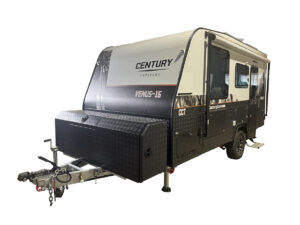
The Venus 13 uses a true north-south twin-bed arrangement within a 13ft body. It combines this with an in-built shower-and-toilet ensuite, an internal kitchen and a larger touring system than the 11 Plus, including 150 litres of fresh water, a 200Ah lithium battery and 400 watts of solar.
It provides an example of how moving up by a relatively small amount in length can change the daily experience. Instead of converting a lounge into a bed, each person has a dedicated sleeping space, while the caravan remains within a compact size category.
A fixed queen bed brings convenience but uses more space
For some travellers, a permanent bed is non-negotiable. It remains ready throughout the day, avoids the routine of rearranging cushions and bedding, and generally feels more like a conventional bedroom.
Fitting a fixed queen-size bed into a compact caravan usually requires a longer body and very efficient use of the remaining space. The bed may reduce lounge size or alter the kitchen layout, but many couples consider that a worthwhile exchange for sleeping convenience.
The Venus 14 takes this approach, combining a fixed queen-size bed with a separate toilet and shower in a 14ft layout. It also includes an internal kitchen, outdoor cooking facilities and 160 litres of fresh water.
This is a different interpretation of a small caravan. It is still compact compared with many full-size touring vans, but it places greater emphasis on residential-style comfort. The trade-off becomes clearer in its towing specification: its ATM is higher than those of the Venus 11 Plus and Venus 13, illustrating why caravan length should never be used as a substitute for checking actual weights.
The bathroom affects more than the floor plan
It is easy to think of the ensuite as a single feature, but it influences several other systems within the caravan.
Water capacity determines how independent you can be
A shower can use a surprising amount of water, particularly when two people are travelling. A caravan may technically include an ensuite, but its practical usefulness for free camping depends on tank capacity and how conservatively you use it.
Travellers who mostly stay in caravan parks can refill frequently and use communal facilities when convenient. Those planning more remote stays may require greater fresh-water storage and a suitable grey-water tank.
More water provides greater freedom, but it also adds weight. For example, filling a 150-litre fresh-water system adds up to approximately 150 kilograms compared with travelling empty. Tank placement can also affect towball weight and caravan balance.
When comparing small caravans, consider how many days you realistically want to stay away from a water source, not simply which model has the largest tank.
Hot water and ventilation shape the shower experience
The existence of a shower does not guarantee that it will be pleasant to use.
A suitable hot-water system makes year-round touring much more comfortable, while a well-positioned vent helps remove steam and reduce lingering moisture. This is especially important in a small caravan, where humidity from the bathroom can quickly affect the rest of the interior.
It is worth checking how quickly the water heats, whether the system operates on gas, electricity or both, and how easily the ensuite can be aired after use.
Grey-water capacity matters when camping away from facilities
Water entering the shower and sink needs somewhere to go. In camps where grey water cannot be discharged onto the ground, an onboard grey-water tank becomes important.
The tank should have enough capacity for your typical use and be easy to drain at an approved facility. As with fresh water, the more grey water you carry, the heavier the caravan becomes.
A practical touring routine often involves arriving with the fresh water needed for the stay and leaving with some of that mass transferred into the grey tank. Your total load still needs to remain within the caravan’s limits throughout the trip.
The space you gain in the bathroom must come from somewhere
The key trade-off in any compact ensuite caravan is not whether everything fits. It is what becomes smaller so that everything can fit.
In an 11ft caravan, the bed may need to convert from a lounge. In a 13ft layout, the sleeping arrangement may use singles rather than a queen bed. In a 14ft caravan with a fixed queen bed and separated bathroom, the overall weight and external dimensions may increase.
Kitchen bench space is another common compromise. A compact caravan may provide everything needed to prepare simple meals but offer less uninterrupted bench area than a larger van. Storage can also be more carefully allocated, with limited room for bulky items or extended-trip supplies.
These are not necessarily design flaws. They are the natural result of prioritising mobility and self-containment. The best layout is the one that reduces the compromises you will notice most often.
Someone who cooks outdoors most of the time may happily accept a smaller internal kitchen. A couple who dislikes making a bed each evening may prefer a larger caravan with a fixed bed. Travellers who rarely shower inside the caravan may prioritise a smaller wet bathroom and gain more living space elsewhere.
Compact does not automatically mean lightweight
One of the most important misconceptions about small caravans is that every compact model can be towed by a small vehicle.
Length and weight are related, but they are not the same. A short caravan with a strong chassis, generous water storage, lithium batteries, solar equipment, an air conditioner and a full bathroom can weigh considerably more than its appearance suggests.
The relevant figures include ATM, tare weight, payload and towball weight, along with the tow vehicle’s braked towing capacity, GVM, GCM, rear-axle limit and maximum towball download.
Within the compact Venus range, the published ATMs illustrate the variation:
- Venus 11 Plus: 1800kg ATM
- Venus 13: 1900kg ATM
- Venus 14: 2500kg ATM
These figures are maximum permitted loaded weights rather than the weight every caravan will have on every trip. Nevertheless, they show why a buyer should not assume that moving from an 11ft to a 14ft caravan is a minor towing change.
Options, accessories and final build specifications may also affect weight, so the compliance plate and current specifications should always be checked before purchase.
Is a small caravan suitable for long trips?
For many couples, yes.
A well-designed small caravan can be comfortable for extended touring if its layout suits the occupants and there is enough payload for their gear. In fact, some travellers prefer compact vans precisely because they move regularly and value easy setup, simpler parking and a less intimidating towing combination.
The question is not whether the caravan is objectively large enough. It is whether the way it uses space matches your habits.
Couples who spend most of the day outdoors may find an 11ft or 13ft caravan completely adequate. The interior becomes a comfortable place to sleep, shower, cook when necessary and escape poor weather.
Travellers who spend long evenings inside, carry extensive equipment or want a permanent queen bed and more bathroom separation may be happier in a 14ft model or larger.
Before choosing, imagine several consecutive wet days rather than only ideal camping weather. Ask whether you could cook, dress, relax and move around one another comfortably. That mental test often reveals more than a quick showroom inspection.
Choosing between an 11ft, 13ft and 14ft ensuite caravan
The right size becomes clearer when you decide which convenience matters most.
The Venus 11 Plus places the greatest emphasis on compactness. Its convertible lounge-and-bed system allows a private ensuite and indoor kitchen to fit within an 11ft body. It suits couples who want a lighter, highly manageable caravan and are comfortable converting the sleeping area.
The Venus 13 adds permanent twin beds, greater water storage and more substantial off-grid power while keeping the ATM below 2000kg. It may suit couples who want easier bed access and longer self-contained stays without moving immediately into a much heavier caravan.
The Venus 14 prioritises fixed-bed and bathroom comfort. Its queen bed and separate shower and toilet create a more residential experience, while the internal and external cooking arrangements support longer touring. In exchange, it has a larger footprint and higher ATM that require a suitably matched tow vehicle.
None is simply a smaller or larger version of the same idea. Each represents a different answer to the question: Which comfort are you least willing to give up?
What to check when inspecting a small ensuite caravan
A floor plan is useful, but it cannot show how the caravan feels when two people are using it.
When inspecting a model, both travellers should step inside together. One person should stand at the kitchen while the other moves between the bed and bathroom. Open the fridge, cupboards, bathroom door and storage compartments to see whether they obstruct the main walkway.
Sit on the bed or lounge rather than looking at it. Stand inside the shower and check headroom. Imagine where wet towels, shoes, toiletries and bedding will go. Consider whether the toilet can be used comfortably and whether the ensuite door provides enough privacy.
Then look beyond the interior. Check tank capacities, battery and solar specifications, available payload, external storage and the total towing dimensions. These details determine whether the caravan remains practical once it is loaded for a real trip.
Are the compromises worth it?
For travellers who value maximum interior space, a small caravan may always feel restrictive. A larger model can provide a bigger lounge, longer kitchen, more storage and a more generous bathroom without requiring every area to serve multiple purposes.
But more space brings its own trade-offs: greater weight, more demanding storage, a longer towing combination and potentially less flexibility in compact campsites.
That is why small caravans with a shower and toilet appeal to so many couples. They are not trying to recreate a full-size home. They are trying to retain the comforts that matter while removing the size they do not need.
When the layout matches the owners, the caravan does not necessarily feel small. It feels efficient.
Frequently asked questions
What is the smallest caravan with a shower and toilet?
Caravans around 11ft can include an internal shower and toilet, although the exact layout varies. Very compact models often use a combined wet bathroom and a lounge that converts into a bed to make the most of the available space.
Can a small caravan have a separate shower and toilet?
Yes, although greater separation generally requires more floor area. The 14ft Venus 14, for example, combines a fixed queen-size bed with a separate toilet and shower. Smaller models are more likely to use a combined or closely integrated ensuite.
Are small caravans with bathrooms suitable for free camping?
They can be, provided their water, grey-water, battery and solar systems match the intended length of stay. Tank capacity, power usage and payload should all be considered together.
Are small caravans easier to tow?
They may be easier to manoeuvre than longer vans, but size alone does not determine towability. Check the caravan’s actual loaded weight, towball load and the limits of the tow vehicle.
Is a convertible bed suitable for long trips?
That depends on personal preference. A convertible lounge maximises daytime space and keeps the caravan compact, but it requires the bed to be made and packed away. Some travellers enjoy that flexibility, while others strongly prefer a permanent bed.
How much water does a couple need in a caravan?
Usage varies considerably. Drinking, cooking and short showers may use far less water than normal household routines, but travellers should estimate their actual needs and consider where they can refill. Carrying more water increases the caravan’s loaded weight.
Finding the right compact caravan
Choosing a small caravan with a shower and toilet is ultimately an exercise in priorities.
The smallest layout may give you greater towing and storage flexibility. A slightly longer model may provide permanent beds, more water or a more comfortable bathroom. Moving up again can deliver a fixed queen bed and separated shower and toilet, but with higher weight and towing requirements.
The best way to decide is to compare the layouts in person and think beyond the first weekend. Consider how you sleep, where you cook, how often you use the shower, how much water you carry and how much interior space you need during poor weather.
For practical examples of these different approaches, compare the Venus 11 Plus, Venus 13 and Venus 14. Each provides an internal shower and toilet for two people, but each balances sleeping, bathroom space, power, water and towing weight differently.
Rather than asking which one has the most features, ask which layout would make your own trips feel easiest.
Tags :
example, category, and, terms