




What Caravans Not to Buy in Australia: A Practical Buyer’s Checklist
A 16ft caravan is often described as the “sweet spot” size for couples. It’s big enough to feel like a proper caravan, but compact enough that towing and parking don’t feel like a full-time job.
So the question people naturally ask next is simple: Is a 16 foot caravan actually easy to tow?
For many drivers, the answer is yes. It’s easier than a longer van, but it comes with an important caveat: “easy” isn’t determined by length alone. Towability depends on a handful of factors working together: the caravan’s weight and balance, your tow vehicle’s limits, how you load both, and whether the combination feels stable at speed.
This article breaks down what makes a 16ft caravan feel manageable, what can make it feel harder than expected, and how to check your setup before you buy.
Why 16ft often feels easier than larger caravans
When people say a 16ft caravan is easy to tow, they’re usually talking about the everyday driving moments: turning corners, changing lanes, reversing into sites, and dealing with wind or traffic. A shorter caravan generally helps with:
Manoeuvrability
A smaller footprint is easier to place on the road and less stressful in tight service stations, caravan parks, or narrow driveways.
Reversing
Reversing a caravan is about controlling angles and reacting early. Many people find a shorter van easier to correct because you’re managing less overall length and often less “swing”.
Route flexibility
Compact vans can feel less intimidating on regional roads, in smaller towns, or when you’re trying to find a last-minute stop.
Touring rhythm
If you move frequently, enjoying spending a night here and two nights there, a 16ft setup can feel like it fits the way you travel. You can stop, set up, and keep moving without feeling like everything takes effort.
That said, none of these benefits override the fundamentals. A 16ft caravan that’s heavy, poorly loaded, or paired with the wrong vehicle can still feel unpleasant to tow.
The real factors that decide whether a 16ft caravan is “easy” to tow
1) Weight (ATM and your real touring load)
Most buyers understand towing capacity, but the practical question is always: what will the caravan weigh when you actually travel?
Touring adds weight quickly:
- water (especially if you free camp)
- batteries and power upgrades
- food, clothes, tools
- outdoor gear, chairs, cooking kit
- bikes and storage add-ons
A 16ft caravan can still be a serious touring setup. If you plan to travel loaded and self-sufficient, you want to check weights early so you’re not surprised later.
If you want the simplest mental model: a caravan that’s easy to tow is one that your vehicle can tow comfortably, not just “technically”.
2) Towball weight (often the quiet limiter)
Towball weight is one of the most common reasons a towing setup feels heavier than expected. Because towball weight is carried by the vehicle, it affects:
- vehicle payload/GVM headroom
- rear axle load
- how the vehicle sits (rear sag)
- steering and braking feel
This is why a towing setup can be under the vehicle’s tow rating but still feel wrong. If your vehicle is already loaded with passengers and gear, towball weight can be what pushes the combination into “tight” territory.
3) Balance and loading (a 16ft caravan can still tow badly if packed badly)
A compact caravan doesn’t automatically mean stable towing. Stability comes from how weight is distributed. In general:
- heavy items low and near the axle line tend to tow better
- heavy weight at the rear can increase sway risk
- loading the front boot heavily can push towball weight up quickly
If a 16ft caravan is packed thoughtfully, it often feels calm and predictable. If it’s packed like a storage unit, it can feel twitchy.
4) Wind and passing trucks (shorter helps, but setup matters)
A shorter van can feel less “sail-like” than a longer one, but wind behaviour still depends on the whole combination. If the caravan is light on the ball or rear-heavy, crosswinds and trucks passing can feel more dramatic.
A stable towing setup should feel like it tracks straight with minimal correction. If you’re constantly working the steering wheel, it’s worth reviewing loading and towball weight, not just blaming the wind.
5) Your vehicle setup and experience level
An experienced tower can make many setups look easy. But the point isn’t to be a hero. It’s to choose a combination that makes touring enjoyable.
If you’re newer to towing, a 16ft caravan can be an excellent learning size, especially if:
- your tow vehicle has healthy payload headroom
- you’re not pushing limits
- you practise reversing and take time to get comfortable
A calm combination builds confidence quickly.
What does “easy to tow” feel like in real life?
If you’re trying to picture it, an “easy” towing setup usually feels like:
- the vehicle remains level and controlled (no excessive rear sag)
- steering still feels planted
- braking feels predictable
- the caravan tracks straight at highway speed
- reversing is manageable with small corrections
- wind and trucks are noticeable but not alarming
If your setup feels like that, towing stops being stressful and starts being part of the fun.
A quick way to check if your vehicle and a 16ft caravan are a good match
If you’re shortlisting a 16ft caravan, the best approach is to do a simple “system check” early, before you fall in love with a layout.
- Confirm the caravan’s ATM and typical towball weight range
- Check your vehicle’s maximum towball download and payload headroom
- Factor in your real passenger load and touring gear
- If you’re planning off-grid trips, include water and power upgrades in your assumptions
- If you’re close to limits, plan a weighbridge check once you’re set up
If you want a step-by-step walkthrough, our towing guides make this process much easier:
- ATM vs Tare vs GTM: Caravan Weights Explained
- Can I Tow a Caravan? (Step-by-step)
- Towball Weight Explained
- How to Load a Caravan Safely
Those pages exist for one reason: so you don’t have to guess.
How this relates to the Venus 16 range at Century Caravans
The reason 16ft remains such a popular size category is that it suits real touring behaviour: comfortable for couples, manageable day-to-day, and versatile for mixed travel.
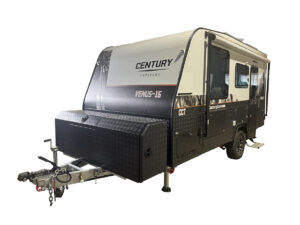
That’s also the space where the Century Caravans Venus 16 range sits. Whether you’re looking at the Venus 16 On Road for touring routes and sealed-road travel, or the Venus 16 Off Road for more mixed-road confidence, the underlying idea is the same: keep the footprint touring-friendly while still delivering “proper caravan living” including the kind of comforts that matter over long trips.
If towing confidence is your priority, a 16ft caravan is often a very sensible place to start, especially when it’s matched to your tow vehicle and loaded thoughtfully.
FAQ
Is a 16 foot caravan easier to tow than a 19 foot caravan?
Often, yes. A shorter van can feel easier to manoeuvre and reverse. But towability depends on weight, towball load, vehicle payload, and how the caravan is packed.
Do I need a big 4WD to tow a 16ft caravan?
Not always. It depends on the caravan’s ATM and your vehicle’s towing and payload limits. Many buyers focus too much on tow rating and not enough on towball download and payload.
What’s the biggest mistake people make when towing a 16ft caravan?
Assuming “short = easy” and ignoring towball weight and load distribution. A compact van can still feel unstable if loaded poorly or paired with a tight vehicle setup.